Barbell Curl
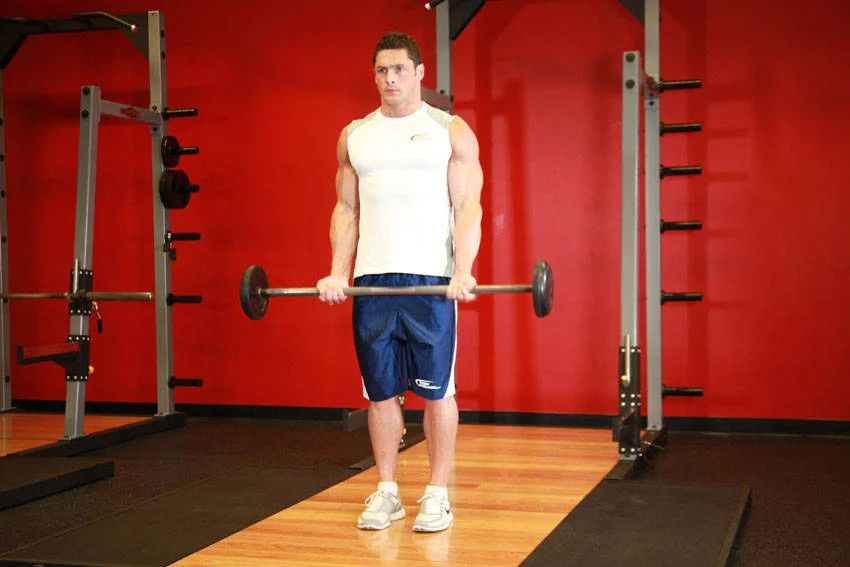
The barbell curl is the king of bicep mass builders, allowing you to load maximum weight for progressive overload. This bilateral movement creates balanced development and delivers unmatched tension for building thick, powerful biceps from insertion to origin.
Muscles Worked
Primary Muscles
- Biceps Brachii (Long & Short Head)
- Brachialis
Secondary Muscles
- Brachioradialis
- Wrist Flexors
- Anterior Deltoid (Stabilization)
How to Perform
-
1
Setup: Stand with feet hip-width apart, holding a barbell with an underhand (supinated) grip at shoulder-width. Let the bar hang at arm's length against your thighs. Pull your shoulders back, engage your core, and keep your chest up with a neutral spine.
-
2
Initiate the Curl: Keep your upper arms completely stationary and pinned to your sides. Begin curling the bar up by flexing at the elbows only. Focus on squeezing your biceps, not using your back or shoulders. Your elbows should stay in a fixed position throughout—they don't move forward or backward.
-
3
Curl to Peak: Continue curling until the bar reaches upper chest level, just below your chin. At the top, your forearms should be vertical and your biceps fully contracted. Squeeze hard for a 1-second count. Avoid letting the bar drift away from your body or bringing your elbows forward.
-
4
Control the Descent: Lower the barbell slowly and with complete control back to the starting position. Take 3-4 seconds on the way down, resisting gravity throughout the entire range. This eccentric phase is critical for muscle growth. Keep constant tension on your biceps.
-
5
Reset and Repeat: At the bottom, fully extend your arms without locking out or relaxing the biceps. Maintain perfect posture—no swinging, rocking, or using momentum. Your body should remain completely still with only your forearms moving. If you need to cheat, reduce the weight.
Common Mistakes
-
Excessive Body English
Leaning back and using hip thrust to swing the weight turns this into a momentum exercise, not a muscle builder. The weight is too heavy if you need to cheat. Keep your torso vertical and locked—biceps should do 100% of the work.
-
Moving Elbows Forward
When your elbows drift forward during the curl, your front delts take over and your biceps lose tension. Lock your elbows in place at your sides or slightly behind your torso. Only your forearms should move—upper arms stay completely still.
-
Grip Too Wide or Too Narrow
A grip that's too wide limits range of motion, while too narrow puts excessive stress on wrists and shifts work to forearms. Use a shoulder-width grip where forearms are vertical at the top of the curl for optimal bicep recruitment.
-
Rushing the Negative
Dropping the bar quickly back to start wastes half the muscle-building stimulus. The eccentric phase causes the most muscle damage and growth. Lower the bar slowly over 3-4 seconds, fighting gravity every inch of the way.
Pro Tips
-
Use an EZ-Bar for Wrist Comfort
If straight bar curls hurt your wrists or forearms, switch to an EZ-curl bar. The angled grip reduces wrist strain while still providing excellent bicep stimulation. It's especially useful for higher rep sets where wrist fatigue becomes an issue.
-
Curl Against a Wall
Stand with your back against a wall to eliminate all body movement. This forces strict form and ensures your biceps do all the work. You'll likely need to drop the weight by 10-15%, but the quality of tension will dramatically improve muscle growth.
-
Start Reps from a Dead Stop
At the bottom of each rep, pause for a full second before the next curl. This eliminates the stretch reflex and momentum, making each rep harder but more effective. Dead-stop curls build explosive strength and true bicep power.
-
Think About Driving Pinkies Up
Instead of thinking "curl the bar," focus on driving your pinky fingers up toward the ceiling. This mental cue maximizes supination and engages the short head of the bicep, which creates that peaked look. Small cue, big results.
Variations
EZ-Bar Curl
Angled grip reduces wrist strain while maintaining excellent bicep stimulation.
Wide Grip Barbell Curl
Wider hand position emphasizes the short head for greater bicep peak development.
Close Grip Barbell Curl
Narrow grip targets the long head for increased overall arm thickness.
Drag Curl
Pull the bar up along your torso for a unique stimulus and peak contraction.
Alternatives
Dumbbell Curl
Unilateral movement allowing independent arm development and natural supination.
Cable Biceps Curl
Maintains constant tension throughout the movement for superior pump.
Preacher Curl
Eliminates momentum completely for pure bicep isolation and peak development.
Related Arm Exercises

Track Your Barbell Curl Progress
Log every set, track your personal records, and watch your strength grow with replogr. The offline workout tracker built for serious lifters.
Download replogr.