Back Extension
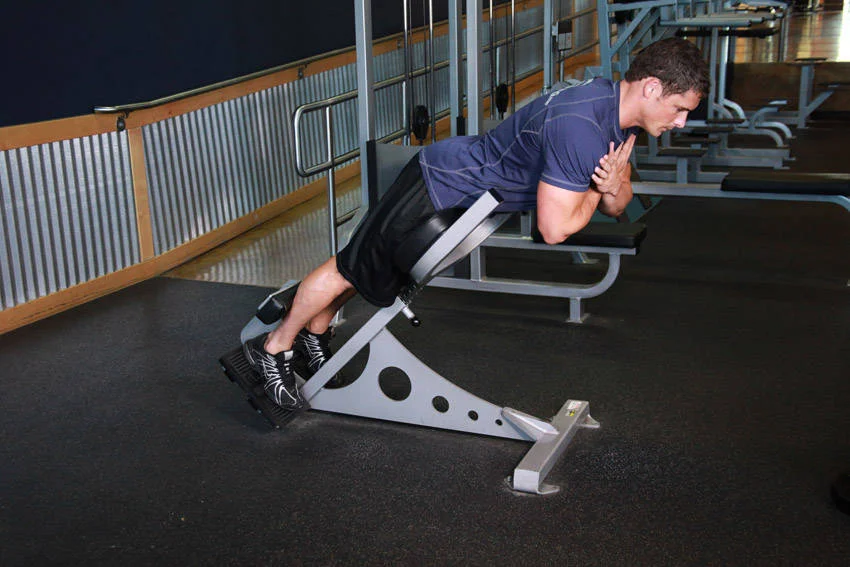
The back extension strengthens your erector spinae and posterior chain, essential for spinal health and deadlift/squat performance. It's both a strength exercise and injury prevention tool.
Muscles Worked
Primary Muscles
- Erector Spinae
- Glutes
Secondary Muscles
- Hamstrings
- Lower Back Muscles
How to Perform
Position yourself on a back extension bench with hips on the pad and feet secured.
Start with your torso bent forward at about 90 degrees, arms crossed over chest.
Keep your back straight and core engaged throughout the entire movement.
Raise your torso up by contracting your lower back and glutes until body is in line.
Pause briefly at the top, squeezing your glutes and lower back.
Lower back down to starting position with control, feeling a stretch in your hamstrings.
Common Mistakes
Hyperextending at the Top
Arching excessively past neutral puts unnecessary stress on lumbar spine. Stop at body alignment.
Rounding Lower Back
Letting your back round reduces muscle activation and increases injury risk.
Using Momentum
Bouncing at the bottom eliminates tension and reduces effectiveness of the exercise.
Looking Up During Movement
Craning neck upward creates cervical spine strain. Keep neck neutral throughout.
Training Notes
Back Extension works best when the torso stays quiet and the shoulder blades do the initial movement. Set the chest up, keep ribs down, and drive the elbows toward the hips or back pockets. If your neck tenses up, reset with a longer spine and keep the gaze neutral.
Think about squeezing the mid‑back at the end of each rep rather than yanking the handle. A 1–2 second pause in the contracted position teaches control and builds thickness. On the way back, let the shoulder blades glide forward for a full stretch without losing posture.
For growth, 3–4 sets of 8–15 reps with a controlled eccentric works well. For strength, use heavier loads in the 5–8 rep range and longer rests. Straps are fine if grip limits the back; just keep the pull strict and avoid shrugging.
If you feel it more in the biceps than the back, slightly reduce the grip strength and think “elbows first.” A neutral wrist and a relaxed grip can help the lats engage. Adjust the handle height or torso angle to keep the line of pull aligned with the target fibers.
Protect the lower back by keeping the core braced and the chest supported whenever possible. If you use free weights, avoid jerking with the hips. A smooth eccentric builds more tissue and keeps the shoulder joint happy over the long term.
Pair Back Extension with a vertical pull on the same day to cover the full back. For example, do a row‑dominant movement first, then a pulldown or pull‑up. Keep total weekly volume for back around 12–20 quality sets, adjusted to recovery.
A slightly wider grip typically emphasizes upper‑back thickness, while a closer grip shifts more load to the lats. Test both and keep the one that lets you feel the target area most. The best grip is usually the one that allows a smooth, pain‑free path.
Use a light warm‑up set to find the right shoulder position, then lock that in for your working sets. If the lower back tires before the upper back, reduce load and add a chest‑supported variation for a few weeks.
Pro Tips
Focus on squeezing your glutes hard at the top for maximum posterior chain activation.
Keep your neck in neutral alignment with your spine - imagine holding an orange under your chin.
Start with bodyweight only, then progress to holding a plate across your chest for resistance.
Perform 3-4 sets of 12-15 reps as part of your deadlift or squat warm-up for lower back activation.
Variations
45-Degree Back Extension
Use a 45-degree bench angle to change leverage and reduce difficulty slightly.
Weighted Back Extension
Hold a weight plate across your chest or behind head for added resistance.
Single-Leg Back Extension
Perform one leg at a time for increased glute activation and balance challenge.
Alternative Exercises
Romanian Deadlift
Hip hinge movement that loads the entire posterior chain with heavier weight.
Good Morning
Barbell exercise targeting erector spinae and hamstrings similarly.
Reverse Hyper
Alternative lower back exercise that decompresses the spine while working erectors.
Bird Dog
Core stability exercise that strengthens lower back with minimal spinal loading.

Track Your Back Extension Progress
Log every set, track PRs, and watch your strength grow with replogr.
Join Beta