Barbell Row
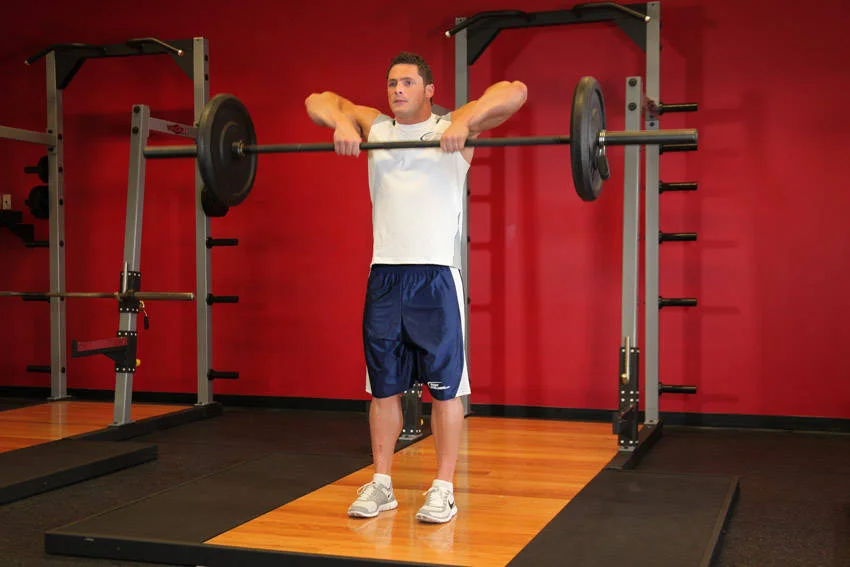
The barbell row builds back thickness and strength through horizontal pulling. It's a compound movement that develops your entire posterior chain when done correctly.
Muscles Worked
Primary Muscles
- Latissimus Dorsi
- Rhomboids
- Middle Trapezius
Secondary Muscles
- Rear Deltoids
- Biceps
- Erector Spinae
How to Perform
Stand with feet shoulder-width apart, holding a barbell with overhand grip slightly wider than shoulders.
Hinge at hips to about 45-degree torso angle, keeping back straight and knees slightly bent.
Let the bar hang at arms' length, maintaining neutral spine throughout movement.
Pull the bar up toward your lower chest/upper abdomen, driving elbows back and up.
Squeeze your shoulder blades together at the top, feeling contraction in your mid-back.
Lower the bar back to starting position with control, maintaining torso angle and tension.
Common Mistakes
Standing Too Upright
A more vertical torso shifts emphasis away from lats to traps, reducing back thickness development.
Jerking the Weight Up
Using momentum and body english reduces back muscle activation and increases injury risk.
Flaring Elbows Out Wide
Elbows going perpendicular to torso shifts work to rear delts instead of lats and mid-back.
Rounding Lower Back
Losing neutral spine position puts dangerous stress on lumbar discs.
Training Notes
Barbell Row works best when the torso stays quiet and the shoulder blades initiate movement. Set the chest up, keep ribs down, and drive elbows toward the hips. Squeeze the mid-back at the end of each rep and hold for 1–2 seconds to build thickness.
For growth, 3–4 sets of 8–15 reps with controlled eccentric works well. For strength, use heavier loads in the 5–8 rep range. If you feel biceps more than back, reduce grip strength and think "elbows first."
Protect the lower back by keeping the core braced. A wider grip emphasizes upper-back thickness, while a closer grip shifts more load to the lats. Pair barbell row with a vertical pull on the same day to cover the full back.
Pro Tips
Think about pulling with your elbows, not your hands, to maximize back muscle recruitment.
Keep the bar path straight up and down - it should travel vertically from start to finish.
Maintain consistent torso angle throughout - don't stand up as you row the weight.
Use straps if grip is limiting you from working your back muscles to failure.
Variations
Pendlay Row
Pull from dead stop on floor each rep for explosive power development.
Underhand Barbell Row
Supinated grip shifts emphasis more to lats and biceps.
T-Bar Row
Supported chest allows heavier loading with reduced lower back fatigue.
Alternative Exercises
Dumbbell Row
Single-arm variation addressing imbalances with support from bench.
Seated Cable Row
Removes lower back demand and provides constant tension through cables.
T-Bar Row
Supported variation allowing heavy loading without lower back fatigue.
Chest-Supported Row
Eliminates lower back involvement completely for pure back isolation.

Track Your Barbell Row Progress
Log every set, track PRs, and watch your strength grow with replogr.
Join Beta