Seated Cable Row
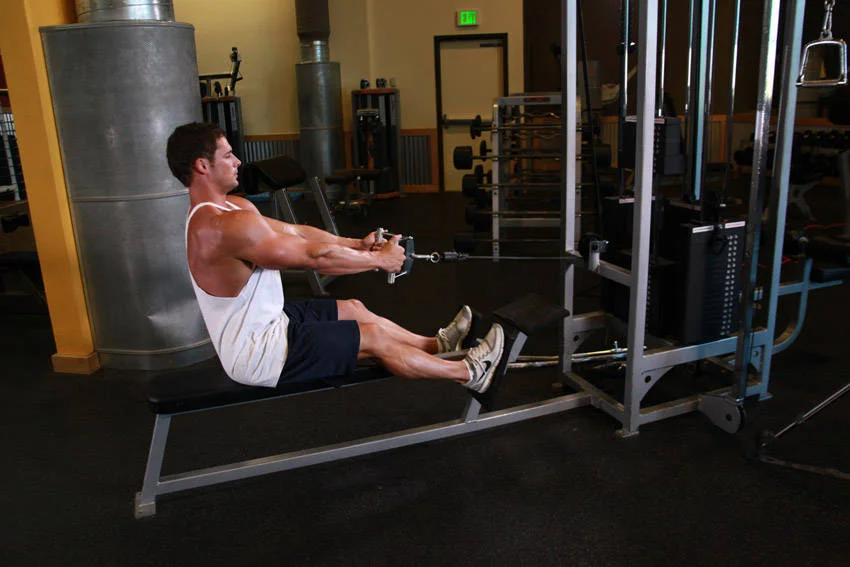
The seated cable row provides constant tension throughout the movement, excellent for building back thickness and teaching proper rowing mechanics with stable support.
Muscles Worked
Primary Muscles
- Latissimus Dorsi
- Rhomboids
- Middle Trapezius
Secondary Muscles
- Rear Deltoids
- Biceps Brachii
- Erector Spinae
How to Perform
Sit at cable row machine with feet on platform and knees slightly bent.
Grasp the handle with both hands and sit upright with arms fully extended forward.
Keep your back straight and core engaged throughout the movement.
Pull the handle toward your lower abdomen, driving elbows back and squeezing shoulder blades.
Keep your torso upright and stable - avoid rocking back and forth.
Extend arms back to starting position with control, feeling a stretch in your lats.
Common Mistakes
Excessive Torso Movement
Rocking forward and back uses momentum and reduces direct back muscle stimulation.
Rounding Lower Back
Allowing spine to round forward puts stress on lumbar discs and reduces muscle engagement.
Pulling Too High
Rowing toward your chest instead of abdomen reduces lat activation and shifts work to upper back.
Shrugging Shoulders
Elevating shoulders shifts emphasis to upper traps instead of lats and mid-back.
Training Notes
Seated Cable Row works best when the torso stays quiet and the shoulder blades do the initial movement. Set the chest up, keep ribs down, and drive the elbows toward the hips or back pockets. If your neck tenses up, reset with a longer spine and keep the gaze neutral.
Think about squeezing the mid‑back at the end of each rep rather than yanking the handle. A 1–2 second pause in the contracted position teaches control and builds thickness. On the way back, let the shoulder blades glide forward for a full stretch without losing posture.
For growth, 3–4 sets of 8–15 reps with a controlled eccentric works well. For strength, use heavier loads in the 5–8 rep range and longer rests. Straps are fine if grip limits the back; just keep the pull strict and avoid shrugging.
If you feel it more in the biceps than the back, slightly reduce the grip strength and think “elbows first.” A neutral wrist and a relaxed grip can help the lats engage. Adjust the handle height or torso angle to keep the line of pull aligned with the target fibers.
Protect the lower back by keeping the core braced and the chest supported whenever possible. If you use free weights, avoid jerking with the hips. A smooth eccentric builds more tissue and keeps the shoulder joint happy over the long term.
Pair Seated Cable Row with a vertical pull on the same day to cover the full back. For example, do a row‑dominant movement first, then a pulldown or pull‑up. Keep total weekly volume for back around 12–20 quality sets, adjusted to recovery.
A slightly wider grip typically emphasizes upper‑back thickness, while a closer grip shifts more load to the lats. Test both and keep the one that lets you feel the target area most. The best grip is usually the one that allows a smooth, pain‑free path.
Use a light warm‑up set to find the right shoulder position, then lock that in for your working sets. If the lower back tires before the upper back, reduce load and add a chest‑supported variation for a few weeks.
Pro Tips
Imagine crushing a walnut between your shoulder blades at the peak contraction.
Keep a slight natural arch in your lower back and chest up throughout the movement.
Pull the handle to your lower abdomen/belly button area for maximum lat activation.
Use a 2-1-3 tempo: 2 seconds pulling in, 1 second squeeze, 3 seconds extending out.
Variations
Single-Arm Cable Row
Row one arm at a time to address imbalances and increase core anti-rotation demands.
Wide-Grip Cable Row
Use wide bar attachment to shift emphasis more to mid-back and rhomboids.
Close-Grip Cable Row
Narrow grip for increased lat involvement and range of motion.
Alternative Exercises
Barbell Row
Free weight compound row allowing heavier loading for back thickness.
Dumbbell Row
Single-arm variation with bench support for unilateral back development.
T-Bar Row
Supported barbell row for heavy loading without lower back fatigue.
Machine Row
Fixed path machine version allowing safe training to complete failure.

Track Your Seated Cable Row Progress
Log every set, track PRs, and watch your strength grow with replogr.
Join Beta