Smith Machine Row
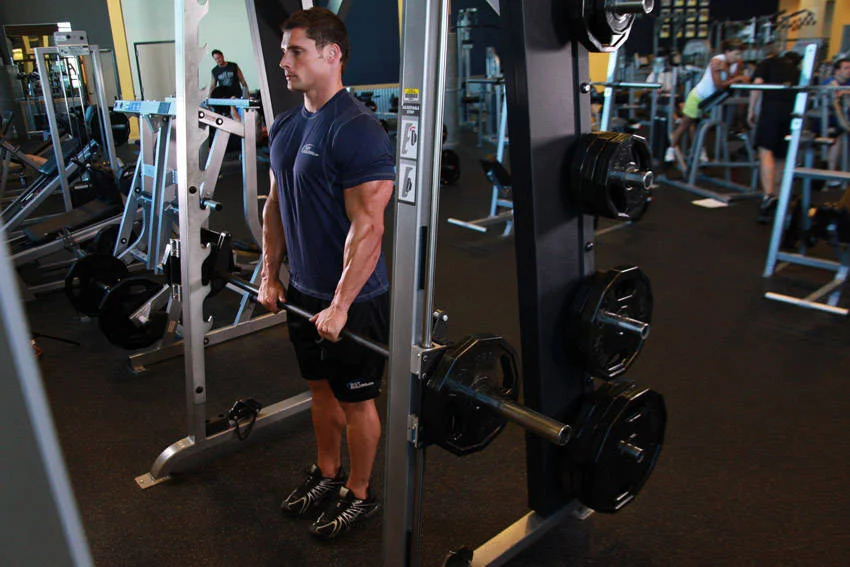
The Smith Machine Row is a controlled rowing movement that allows you to build back thickness and strength with enhanced stability and safety. The fixed bar path of the Smith machine enables you to focus entirely on pulling mechanics without worrying about balance, making it ideal for both beginners learning proper form and advanced lifters pushing heavy weight. This exercise effectively targets the entire back musculature while minimizing lower back strain through the guided movement pattern.
Muscles Worked
Primary Muscles
- Latissimus Dorsi
- Rhomboids
- Middle Trapezius
Secondary Muscles
- Lower Trapezius
- Biceps Brachii
- Rear Deltoids
How to Perform
-
1
Set the bar on the Smith machine to knee height. Load your desired weight and position yourself with feet shoulder-width apart, facing the bar.
-
2
Hinge at your hips and bend your knees slightly until your torso is at approximately 45 degrees. Grasp the bar with an overhand grip slightly wider than shoulder-width.
-
3
Unrack the bar by rotating the hooks. Let your arms hang fully extended while maintaining a neutral spine and engaged core. Your back should be flat, chest up, and shoulders pulled back.
-
4
Initiate the pull by driving your elbows back and squeezing your shoulder blades together. Focus on pulling with your back muscles, not your arms.
-
5
Pull the bar toward your lower chest or upper abdomen, keeping your elbows close to your body. Aim for your elbows to travel past your torso at peak contraction.
-
6
Hold the contracted position for a moment, maximizing the squeeze in your back muscles.
-
7
Lower the bar back to the starting position with control, fully extending your arms while maintaining tension in your back. Keep your torso angle consistent throughout.
Common Mistakes
-
Rounding the Lower Back
Allowing your lower back to round during the movement places excessive stress on your lumbar spine and reduces power transfer. Maintain a neutral spine throughout by engaging your core and keeping your chest up.
-
Standing Too Upright
An excessively upright torso angle turns this into more of an upright row, shifting emphasis away from the lats and mid-back. Maintain a 30-45 degree forward lean for optimal back engagement.
-
Using Excessive Momentum
Jerking the weight up or changing your torso angle to generate momentum reduces back muscle activation and increases injury risk. Control the movement through your entire range of motion.
-
Flaring Elbows Too Wide
Letting your elbows flare excessively outward shifts tension to the rear delts and increases shoulder strain. Keep your elbows at approximately 45 degrees from your torso for optimal lat and mid-back activation.
Pro Tips
-
Experiment with Bar Height
Try different starting heights to find your optimal position. A lower bar height increases range of motion and stretch, while a higher position may allow for heavier loads and emphasize the squeeze at the top.
-
Use the Fixed Path to Your Advantage
Since the bar follows a fixed path, you can safely push to failure without a spotter. Use this stability to focus on maximum contraction and perfect your mind-muscle connection with your back.
-
Try Different Grip Widths
A wider grip emphasizes the outer lats and upper back, while a narrower grip targets the middle back and inner lat fibers more directly. Vary your grip width across training sessions for complete development.
-
Incorporate Pauses for Strength
Add 2-3 second pauses at the top of each rep to eliminate momentum and increase time under tension. This technique significantly enhances muscle growth and improves your ability to achieve peak contraction.
Variations
These Smith Machine Row variations allow you to target different areas of your back and accommodate various training goals and experience levels.
-
Underhand Grip Smith Machine Row
Using a supinated (palms-up) grip increases bicep involvement and emphasizes the lower lats. This variation allows for a slightly closer grip and different pulling angle.
-
Wide-Grip Smith Machine Row
Taking a grip wider than shoulder-width emphasizes the upper lats, rear delts, and rhomboids. This variation creates a different angle of pull for comprehensive back development.
-
Chest-Supported Smith Machine Row
Set an incline bench under the bar and lie chest-down for support. This eliminates lower back involvement entirely, allowing you to isolate your back muscles completely.
-
Single-Arm Smith Machine Row
Perform the row one arm at a time to address strength imbalances and increase range of motion. This unilateral variation also enhances core stability requirements.
Alternative Exercises
If you don't have access to a Smith machine or want to vary your training stimulus, these alternatives provide similar back-building benefits.
-
Barbell Bent-Over Row
The free-weight classic that requires more stabilization and balance. Barbell rows engage more core muscles and allow for a natural bar path, though they demand better technique.
-
T-Bar Row
A landmine or T-bar station provides a similar guided movement pattern with a neutral grip option. This variation often allows for heavier loading and reduced lower back strain.
-
Cable Seated Row
A cable machine provides constant tension throughout the movement with chest support. This variation eliminates lower back involvement while maintaining similar pulling mechanics.
-
Pendlay Row
A more explosive rowing variation where the bar returns to the floor between reps. This builds power and strength while maintaining strict form through the reset position.

Track Your Smith Machine Row Progress
Log every set, track PRs, and watch your strength grow with replogr.
Join Beta