Straight-Arm Pulldown
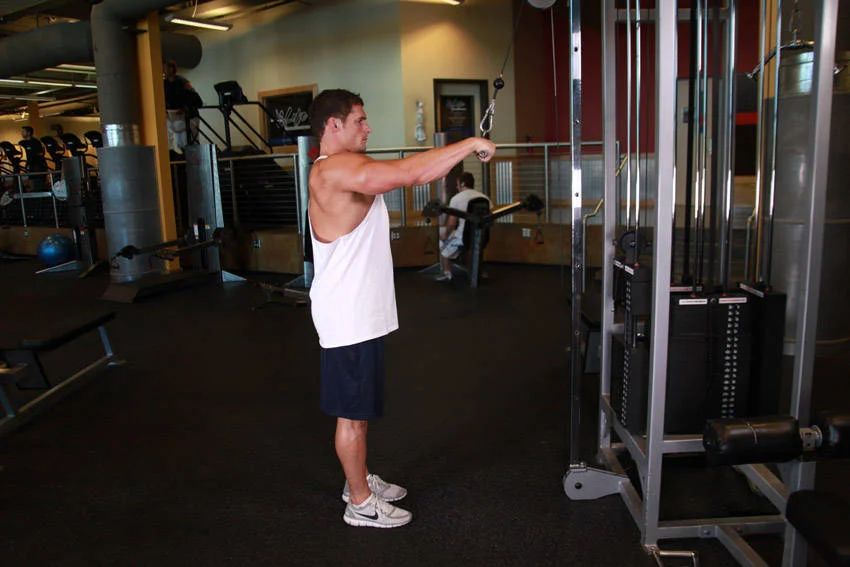
The straight-arm pulldown is an isolation exercise that targets the lats through a unique movement pattern that keeps tension on the back muscles throughout the entire range of motion. Unlike traditional pulldowns, this exercise minimizes bicep involvement by keeping the arms straight, making it an excellent movement for developing lat width and improving mind-muscle connection with your back.
Muscles Worked
Primary Muscles
- Latissimus Dorsi
- Lower Pectorals
Secondary Muscles
- Triceps
- Rear Deltoids
- Core Stabilizers
How to Perform
-
1
Attach a straight bar or rope handle to a high cable pulley. Stand facing the machine with your feet shoulder-width apart, maintaining an upright posture.
-
2
Grip the bar with an overhand grip, hands about shoulder-width apart. Take a step back and allow your arms to extend fully overhead, creating slight tension in the cable.
-
3
Keep your arms straight with only a slight bend in the elbows throughout the movement. Engage your core and maintain a neutral spine with a slight forward lean.
-
4
Pull the bar down in a sweeping arc motion toward your hips by contracting your lats. Focus on driving your elbows down and back while keeping your arms extended.
-
5
Continue pulling until the bar reaches your upper thighs and your lats are fully contracted. Hold the squeeze for a brief moment at the bottom position.
-
6
Slowly reverse the movement in a controlled manner, allowing the bar to return to the starting position overhead while maintaining constant tension in your lats.
-
7
Repeat for the desired number of repetitions, maintaining the same movement pattern and keeping your arms straight throughout the entire set.
Common Mistakes
-
Bending the Elbows
The most common error is bending the elbows significantly during the movement, which transforms the exercise into a pulldown and shifts tension away from the lats onto the biceps. Maintain only a slight natural bend in the elbows throughout.
-
Using Too Much Weight
Loading excessive weight forces you to use momentum and compromise form. This isolation exercise requires lighter weight than traditional pulldowns. Focus on feeling the lat contraction rather than moving heavy weight.
-
Excessive Torso Movement
Rocking your torso back and forth or leaning too far forward uses momentum rather than isolating the lats. Keep your torso stable with only a slight forward lean, letting your lats do the work.
-
Shrugging the Shoulders
Allowing your shoulders to elevate during the movement reduces lat engagement and can cause neck strain. Keep your shoulders pulled down and back throughout the entire range of motion.
Pro Tips
-
Think About Pulling Your Elbows Down
Instead of focusing on your hands, imagine driving your elbows down toward your hips. This mental cue helps maximize lat engagement and maintains proper form throughout the movement.
-
Position Your Body Correctly
Stand far enough from the machine that the cable creates a slight forward pull at the start position. This ensures consistent tension on your lats throughout the entire range of motion and prevents slack in the cable at the top.
-
Control the Eccentric Phase
Take 2-3 seconds to return to the starting position on each rep. The controlled eccentric phase increases time under tension and significantly enhances muscle growth stimulus in the lats.
-
Pair with Rowing Movements
Use straight-arm pulldowns as a pre-exhaust before rows or as a finisher after your main back work. This exercise excels at creating a strong mind-muscle connection that carries over to other back exercises.
Variations
Try these variations to target your lats from different angles and add variety to your training:
-
Rope Straight-Arm Pulldown
Using a rope attachment allows for a greater range of motion and a stronger contraction at the bottom as you can pull the rope past your hips.
-
Kneeling Straight-Arm Pulldown
Performing the exercise from a kneeling position increases core engagement and can help you focus more on lat activation by reducing lower body involvement.
-
Single-Arm Straight-Arm Pulldown
Using one arm at a time helps identify and correct strength imbalances while allowing for greater lat stretch and contraction on each side.
-
Resistance Band Straight-Arm Pulldown
Using resistance bands creates increasing tension throughout the movement, providing maximum resistance at peak contraction when your lats are fully shortened.
Alternative Exercises
If you don't have access to a cable machine or want to target similar muscles with different exercises:
-
Dumbbell Pullover
A classic lat isolation exercise performed lying on a bench that provides similar lat stretch and contraction without requiring a cable machine.
-
Lat Pulldown
While allowing elbow flexion, the traditional lat pulldown remains an excellent alternative for building overall lat mass and strength with heavier loads.
-
Pull-Up
The bodyweight pull-up engages the lats through a similar vertical pulling pattern while building functional upper body strength and muscle mass.
-
Machine Pullover
A machine variation that mimics the straight-arm pulldown movement pattern while providing a fixed path and eliminating the need for stabilization.

Track Your Straight-Arm Pulldown Progress
Log every set, track PRs, and watch your strength grow with replogr.
Join Beta