Decline Push-Up
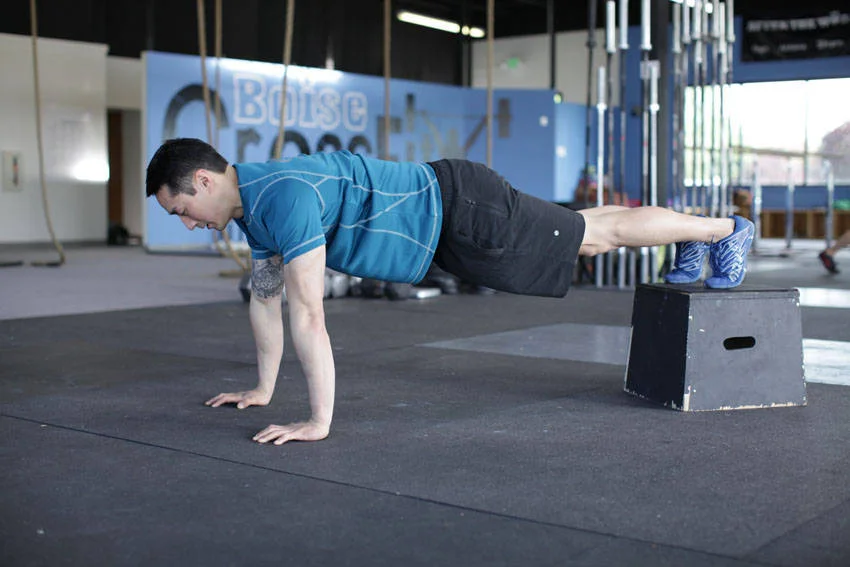
The decline push-up is an advanced bodyweight variation that elevates your feet above your hands, increasing the load on your upper chest and shoulders. This movement shifts more of your body weight forward, demanding greater strength and stability than standard push-ups. It's an excellent progression for developing explosive pressing power and building impressive upper chest development without equipment.
Muscles Worked
Primary Muscles
- Pectoralis Major (Upper Chest)
- Anterior Deltoids
- Triceps Brachii
Secondary Muscles
- Core Stabilizers
- Serratus Anterior
- Hip Flexors
How to Perform
-
1
Place your hands on the floor shoulder-width apart with fingers pointing forward. Position yourself in front of an elevated surface like a bench, box, or sturdy chair.
-
2
Place both feet on the elevated surface behind you, either with your toes on the edge or your shins resting on the surface depending on the height. Your body should form a straight line angled downward from feet to head.
-
3
Engage your core muscles intensely to prevent your hips from sagging. The decline position places more stress on your lower back, so maintain rigid body alignment throughout the entire set.
-
4
Keep your elbows at a 45-degree angle to your body as you begin the descent. Avoid letting them flare directly out to the sides which can stress your shoulder joints.
-
5
Lower your body in a controlled manner until your chest nearly touches the floor. Inhale during the descent and aim for your chest to reach 2-3 inches from the ground while maintaining perfect body alignment.
-
6
Press through your palms explosively to push yourself back up to the starting position. Exhale forcefully as you extend your arms, focusing on squeezing your upper chest and front shoulders.
-
7
Extend your arms fully at the top while maintaining slight elbow bend to keep tension on the muscles. Pause briefly at the top, reset your core brace, and begin the next repetition with control.
Common Mistakes
-
Excessive Hip Sagging
The decline angle increases the tendency for hips to drop, creating dangerous hyperextension in the lumbar spine. This not only reduces chest activation but can cause serious lower back strain and injury over time.
-
Starting Too High
Beginning with feet elevated too high before building adequate strength makes the exercise excessively difficult and compromises form. Start with a 6-12 inch elevation and progress gradually as strength increases.
-
Head Position Errors
Looking up or dropping your head too far down disrupts spinal alignment and can cause neck strain. Keep your head in neutral position with your gaze focused on the floor about 12 inches in front of your hands.
-
Incomplete Range of Motion
Stopping the descent too high because of the increased difficulty cheats you of the full muscle-building benefits. Lower yourself until your chest is 2-3 inches from the floor or as deep as you can go while maintaining form.
Pro Tips
-
Progressive Elevation Strategy
Begin with a 6-inch elevation and master 3 sets of 12-15 reps with perfect form before increasing height. Progress in 4-6 inch increments up to 24 inches maximum, as excessive elevation provides diminishing returns and increases injury risk.
-
Enhanced Core Bracing
Before each rep, take a deep breath and contract your abs as if preparing to be punched in the stomach. Maintain this tension throughout the entire set to protect your spine from the increased gravitational stress of the decline angle.
-
Upper Chest Visualization
Focus on driving your sternum forward and up as you press. Imagine pushing your chest toward the ceiling rather than just extending your arms, which maximizes upper pectoral activation and gets the most benefit from the decline angle.
-
Hand Grip Technique
Actively grip the floor by spreading your fingers and creating tension as if trying to tear the floor apart. This irradiation effect increases total-body tension and stability, allowing you to generate more force and maintain better form under the demanding decline position.
Variations
Challenge yourself with these decline push-up variations that increase difficulty or target muscles differently.
-
Weighted Decline Push-Up
Wear a weighted vest or have a partner place a weight plate on your upper back to significantly increase resistance and build explosive pressing power beyond bodyweight limitations.
-
Decline Diamond Push-Up
Position your hands close together in a diamond shape to dramatically increase triceps involvement while maintaining the upper chest emphasis of the decline angle.
-
Decline Plyometric Push-Up
Explosively push yourself up so your hands leave the ground, developing maximum power output and fast-twitch muscle fiber recruitment in the upper chest and shoulders.
-
Single-Leg Decline Push-Up
Elevate only one foot while keeping the other leg extended in the air, adding significant core stability demands and anti-rotation challenge to the already difficult decline position.
Alternative Exercises
If decline push-ups aren't suitable, these alternatives effectively target the same upper chest and shoulder muscles.
-
Incline Dumbbell Press
Press dumbbells on a 30-45 degree incline bench to directly target the upper chest with adjustable weight, providing similar muscle activation with easier progression tracking.
-
Landmine Press
Press a barbell loaded in a landmine attachment at an upward angle, mimicking the pressing path of decline push-ups while allowing for incremental weight increases.
-
Low-to-High Cable Fly
Pull cable handles from low to high in a fly motion to isolate and develop the upper chest fibers without the stability demands of decline push-ups.
-
Pike Push-Up
Perform push-ups with hips bent and raised high, shifting more emphasis to the shoulders while maintaining some upper chest activation in a more shoulder-dominant movement pattern.

Track Your Decline Push-Up Progress
Log every set, track PRs, and watch your strength grow with replogr.
Join Beta