Flat Dumbbell Bench Press
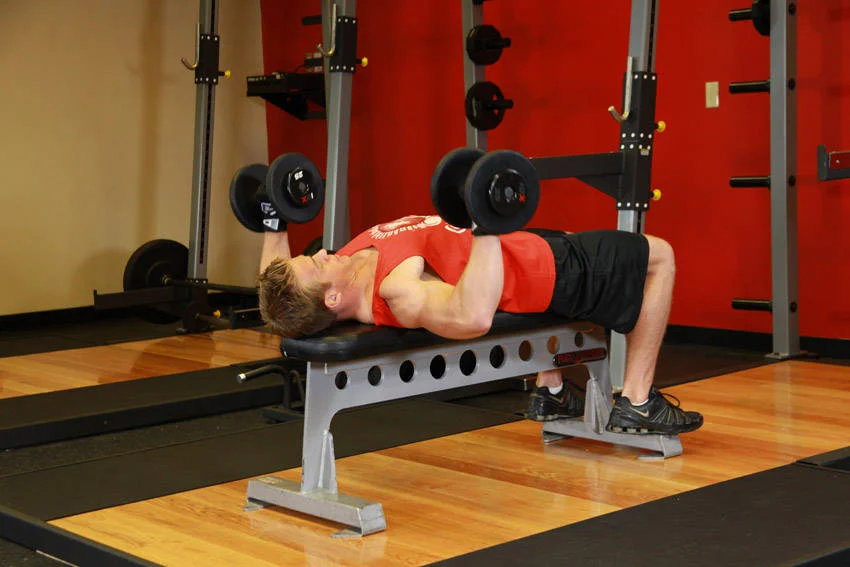
The flat dumbbell bench press is a powerhouse exercise for building chest mass and strength with greater range of motion than the barbell version. This movement allows each side to work independently, correcting strength imbalances while providing a deeper stretch at the bottom for enhanced muscle activation.
Muscles Worked
Primary Muscles
- Pectoralis Major (Chest)
- Anterior Deltoids (Front Shoulders)
- Triceps Brachii
Secondary Muscles
- Serratus Anterior
- Core Stabilizers
- Biceps Brachii (Stabilization)
How to Perform
-
1
Setup: Sit on the edge of a flat bench with a dumbbell resting on each thigh. Lie back while simultaneously bringing the dumbbells to shoulder height, elbows bent at 90 degrees. Plant your feet firmly on the ground and create a slight arch in your lower back.
-
2
Starting Position: Position the dumbbells at chest level with palms facing forward and wrists stacked over elbows. Squeeze your shoulder blades together and press them into the bench. The dumbbells should be slightly wider than shoulder-width apart.
-
3
Lower: Take a deep breath and slowly lower the dumbbells in a controlled arc. Allow your elbows to drop below the level of your chest for a full stretch. Keep elbows at roughly 45 degrees from your torso—not flared out to 90 degrees.
-
4
Pause: At the bottom of the movement, feel the stretch across your chest. Don't let the dumbbells touch or bounce. Maintain tension throughout your core and keep your glutes on the bench.
-
5
Press: Drive through your chest and press the dumbbells back up explosively. The dumbbells should travel in a slight arc, coming together at the top (but not touching). Exhale as you press up.
-
6
Lockout: Squeeze your chest hard at the top position. The dumbbells should be directly over your shoulders with arms fully extended but not locked out. Maintain control before beginning the next rep.
Common Mistakes
-
Flaring Elbows Too Wide
Letting your elbows flare out at 90 degrees puts excessive strain on your shoulder joints and reduces chest activation. Keep elbows at approximately 45 degrees from your torso for optimal power and safety.
-
Not Using Full Range of Motion
Stopping the dumbbells too high robs you of the stretch and muscle activation at the bottom. Lower until your elbows are below bench level for maximum chest engagement.
-
Banging Dumbbells Together
Clanging the dumbbells at the top transfers tension off your muscles and can lead to shoulder instability. Bring them close but maintain a small gap at the peak contraction.
-
Lifting Feet Off the Ground
Losing foot contact reduces stability and leg drive, limiting how much weight you can safely move. Keep feet planted firmly throughout the entire set for a stable base.
Pro Tips
-
Rotate Wrists at the Top
As you press up, slightly rotate your wrists so palms face each other at the peak. This internal rotation creates an extra chest squeeze and maximizes pec activation at lockout.
-
Control the Eccentric
Take 2-3 seconds to lower the weights. The lowering phase builds more muscle than the press, so resist the urge to drop the dumbbells quickly. This time under tension drives serious growth.
-
Use Leg Drive
Push your feet into the ground as you press. This creates full-body tension and allows you to handle heavier weights safely. Your legs contribute more to pressing strength than most people realize.
-
Start Light to Find Your Form
Dumbbells require more stabilization than a barbell. Start with 60-70% of what you'd use for barbell bench press until you've mastered the movement pattern and built stability strength.
Variations
These variations adjust angle, grip, or movement pattern to target different areas of your chest or accommodate specific goals and limitations.
-
Alternating Dumbbell Press
Press one arm at a time while the other holds at the bottom, increasing core demand and time under tension.
-
Paused Dumbbell Press
Hold the dumbbells at the bottom for 2-3 seconds to eliminate momentum and build explosive power from a dead stop.
-
Neutral-Grip Dumbbell Press
Keep palms facing each other throughout the movement to reduce shoulder stress while emphasizing triceps involvement.
-
Floor Press
Perform the press lying on the floor to limit range of motion, ideal for those with shoulder issues or focusing on lockout strength.
Alternative Exercises
If dumbbells aren't available or you want to target your chest from different angles, these exercises provide similar benefits while offering unique stimulus.
-
Barbell Bench Press
The classic compound movement allowing heavier loads but with less range of motion than dumbbells.
-
Push-Ups
Bodyweight alternative that builds chest strength while engaging core stabilizers through the plank position.
-
Chest Press Machine
Fixed path of motion provides stability for beginners and allows training to failure safely without a spotter.
-
Dumbbell Chest Fly
Isolation movement focusing purely on chest without triceps involvement, perfect for finishing work after pressing.

Track Your Flat Dumbbell Bench Press Progress
Log every set, track PRs, and watch your strength grow with replogr.
Join Beta