Neutral-Grip Dumbbell Press
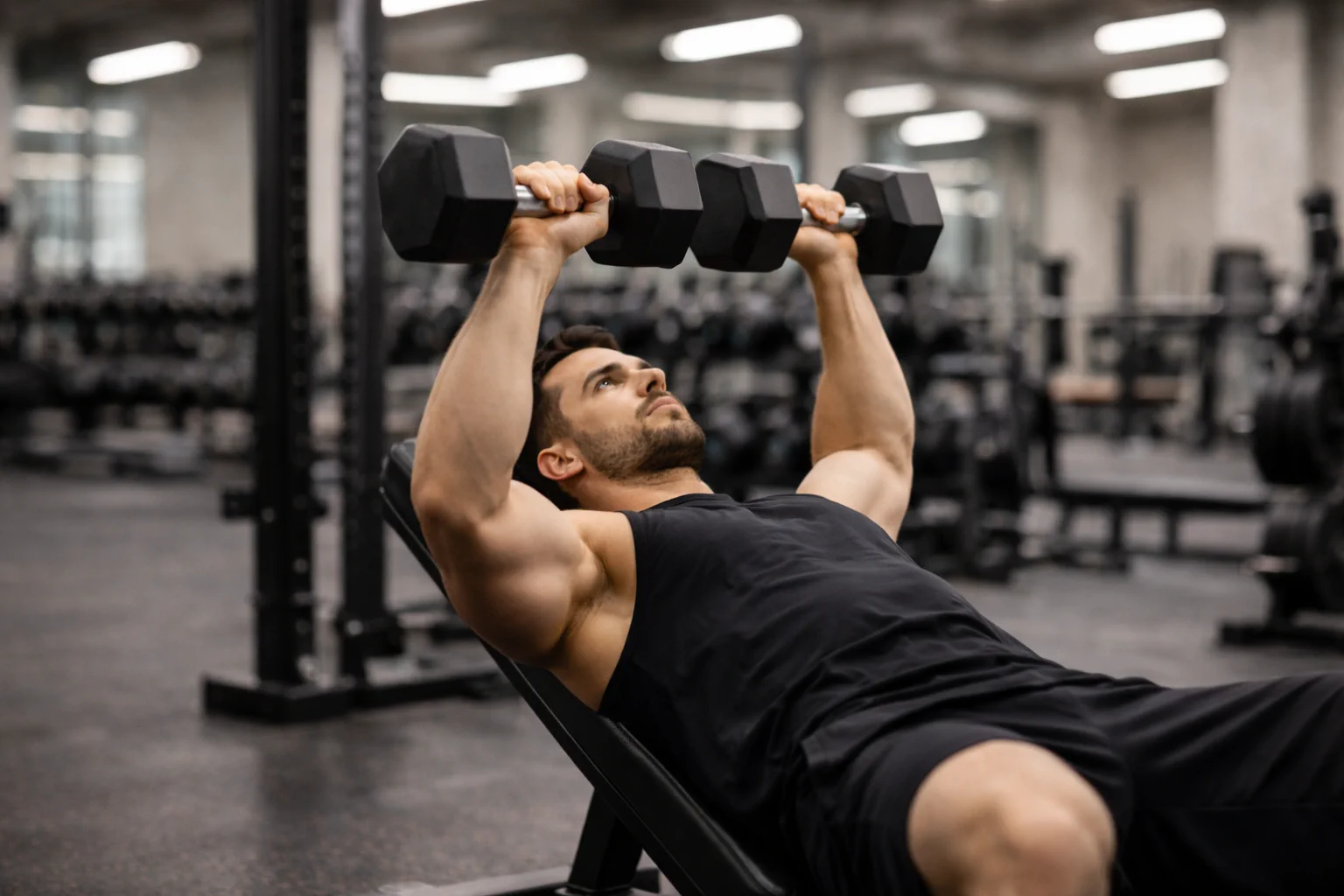
The neutral-grip dumbbell press uses palms facing each other throughout the movement, reducing shoulder stress while delivering intense chest stimulation. This grip variation feels more natural for many lifters and allows the elbows to stay closer to the body, minimizing strain on the shoulder joints. It's an excellent choice for those with shoulder discomfort during traditional pressing movements or anyone seeking to maximize chest activation with enhanced joint safety.
Muscles Worked
Primary Muscles
- Pectoralis Major
- Anterior Deltoids
- Triceps Brachii
Secondary Muscles
- Core Stabilizers
- Serratus Anterior
- Biceps Brachii
How to Perform
-
1
Sit at the end of a flat bench holding two dumbbells resting on your thighs. Use your thighs to help kick the dumbbells up one at a time as you lie back onto the bench.
-
2
Position the dumbbells at chest level with your palms facing each other in a neutral grip. Your elbows should point down toward the floor at approximately 45 degrees to your torso.
-
3
Plant your feet firmly on the floor and create a slight arch in your lower back. Pull your shoulder blades together and press them down into the bench to create a stable pressing platform.
-
4
Press both dumbbells upward simultaneously in a straight path above your chest. Exhale as you push, keeping the neutral grip with palms facing each other throughout the entire pressing motion.
-
5
Extend your arms fully at the top while maintaining the neutral grip, allowing the dumbbells to come close together but not touch. Squeeze your chest muscles hard at peak contraction for a one-second count.
-
6
Lower the dumbbells back down with control to the starting position. Inhale as you descend, taking 2-3 seconds to reach the bottom where your elbows break parallel with your torso.
-
7
Feel the stretch in your chest at the bottom position without allowing the dumbbells to drift too far back toward your head or forward toward your hips. Maintain the neutral grip and repeat for the prescribed repetitions.
Common Mistakes
-
Rotating Grip Mid-Rep
Allowing your palms to rotate outward during the movement defeats the purpose of the neutral grip and increases shoulder stress. Maintain the palms-facing-each-other position throughout the entire range of motion.
-
Excessive Dumbbell Drift
Letting the dumbbells move too far back toward your head or forward toward your waist changes the exercise mechanics and reduces chest activation. Press the dumbbells straight up and down in a vertical path over your chest.
-
Bouncing at the Bottom
Using momentum by bouncing the dumbbells at the bottom of each rep reduces muscle tension and increases injury risk. Control the eccentric phase and pause briefly at the bottom for maximum muscle fiber recruitment.
-
Uneven Pressing
Pressing one dumbbell faster or higher than the other creates muscle imbalances and compromises form. Focus on moving both dumbbells synchronously at the same speed throughout each repetition.
Pro Tips
-
Joint-Friendly Loading
The neutral grip naturally reduces shoulder internal rotation, making this variation ideal for high-rep sets or when training through minor shoulder discomfort. Many lifters can handle more volume with neutral grip compared to pronated grip pressing.
-
Internal Focus Technique
Visualize crushing something between your palms as you press. This internal tension cue activates more chest muscle fibers and creates a powerful mind-muscle connection that enhances hypertrophy stimulus without changing the actual grip position.
-
Strategic Programming
Use neutral-grip presses later in your workout after heavier barbell pressing. The reduced stabilization demands when fatigued make this safer than standard dumbbell presses while still delivering intense chest stimulation for muscle growth.
-
Dumbbell Selection
Choose dumbbells with straight handles rather than those that curve or angle. Straight handles make it easier to maintain the true neutral grip position throughout the set and prevent wrist discomfort that can occur with non-parallel handles.
Variations
Modify the neutral-grip press to target different muscle regions or training goals.
-
Incline Neutral-Grip Press
Perform the movement on a 30-45 degree incline to emphasize the upper chest while maintaining the shoulder-friendly benefits of the neutral hand position.
-
Neutral-Grip Floor Press
Lie on the floor instead of a bench to limit range of motion and reduce shoulder stress further, ideal for those rehabbing injuries or focusing on lockout strength.
-
Alternating Neutral-Grip Press
Press one dumbbell at a time while keeping the other locked out overhead, increasing core stability demands and extending time under tension for the chest muscles.
-
Neutral-Grip Pause Press
Hold a 2-3 second pause at the bottom of each rep to eliminate momentum and build pressing strength from a dead stop, enhancing force production capabilities.
Alternative Exercises
Try these alternatives if neutral-grip dumbbell presses don't fit your needs or equipment availability.
-
Neutral-Grip Cable Press
Use D-handles on a cable machine for continuous tension throughout the range of motion, providing the same shoulder-friendly grip with different resistance curves.
-
Swiss Bar Bench Press
Press a multi-grip bar with parallel handles to achieve neutral grip benefits with heavier loads than dumbbells typically allow, combining the best of both worlds.
-
Push-Ups on Dumbbells
Grip dumbbell handles placed on the floor for a neutral-grip push-up that reduces wrist extension and provides the same shoulder-friendly mechanics in a bodyweight format.
-
Hammer Strength Press
Use a plate-loaded machine with neutral grip handles for guided resistance that mimics the natural pressing path while allowing independent arm movement.
-
Standard Dumbbell Bench Press
Traditional dumbbell press with palms facing forward for maximum chest activation and shoulder mobility demands.
-
Barbell Bench Press
The classic barbell bench press allows heavier loading for building maximum strength and muscle mass.
-
Push-Ups
Bodyweight pressing movement that builds chest strength and can be performed anywhere without equipment.

Track Your Neutral-Grip Dumbbell Press Progress
Log every set, track PRs, and watch your strength grow with replogr.
Join Beta