Captain's Chair Leg Raise
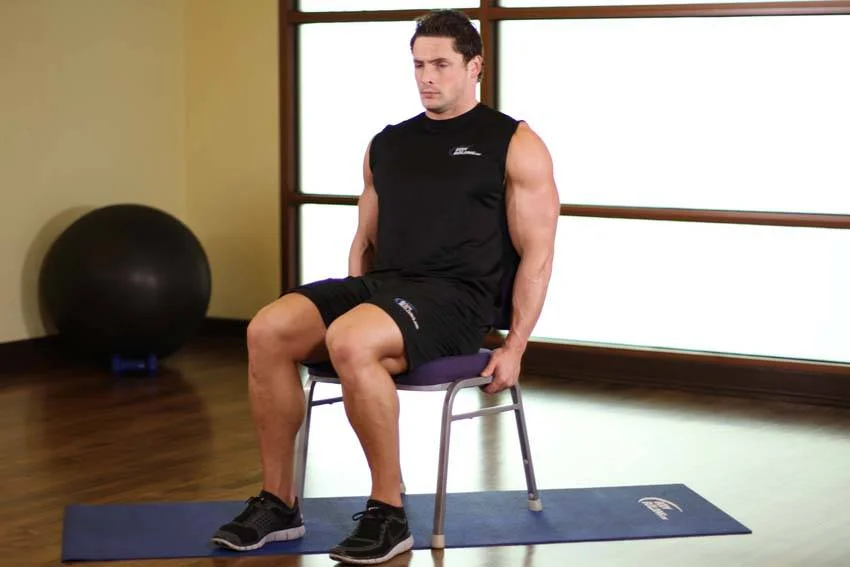
The Captain's Chair Leg Raise is an advanced core exercise that targets the lower abdominals through hip flexion against gravity. This movement provides superior isolation of the rectus abdominis compared to floor-based exercises, making it highly effective for developing core strength and definition. The fixed arm position eliminates momentum, forcing the abs to work harder throughout the entire range of motion.
Muscles Worked
Primary Muscles
- Rectus Abdominis (Lower)
- Hip Flexors (Iliopsoas)
- Rectus Femoris
Secondary Muscles
- Obliques
- Transverse Abdominis
- Quadriceps
How to Perform
-
1
Position yourself in the captain's chair by placing your forearms on the padded armrests and gripping the handles. Press your back firmly against the backrest and allow your legs to hang straight down toward the floor.
-
2
Engage your core by drawing your belly button toward your spine. Keep your shoulders pulled down away from your ears and maintain stable, locked elbows throughout the movement.
-
3
Exhale and lift your knees toward your chest in a controlled motion, using your lower abdominals to initiate the movement. Keep your knees together and bent at approximately 90 degrees.
-
4
Continue raising your knees until your thighs are parallel to the floor or slightly higher. Your hips should curl slightly upward at the top, creating maximum abdominal contraction.
-
5
Hold the top position for one second while maintaining tension in your core. Avoid swinging or using momentum to lift your legs.
-
6
Inhale as you slowly lower your legs back to the starting position with complete control. Resist gravity on the way down to maximize time under tension.
-
7
Immediately begin the next repetition without completely relaxing at the bottom. Maintain constant tension in your abdominals throughout the entire set for optimal results.
Common Mistakes
-
Using Momentum and Swinging
Swinging your legs or using momentum reduces abdominal engagement and increases injury risk. This transforms the exercise from a controlled strength movement into an ineffective momentum-driven motion that fails to properly activate the target muscles.
-
Arching the Lower Back
Allowing your lower back to arch away from the pad places excessive stress on the lumbar spine and shifts the work away from the abdominals. Maintain a neutral or slightly rounded spine by keeping your back pressed firmly against the backrest throughout the movement.
-
Shrugging Shoulders Upward
Elevating your shoulders toward your ears creates unnecessary tension in the neck and upper traps while compromising your stability. Keep your shoulders pulled down and engaged to maintain proper body mechanics and protect your cervical spine.
-
Lowering Legs Too Quickly
Dropping your legs rapidly on the descent eliminates the eccentric contraction phase, which is crucial for muscle development. Control the lowering phase to maximize time under tension and ensure balanced strength development in your core muscles.
Pro Tips
-
Focus on Posterior Pelvic Tilt
At the top of the movement, think about curling your pelvis upward by bringing your pubic bone toward your ribcage. This posterior tilt maximizes lower abdominal activation and ensures you're working the target muscles rather than relying solely on hip flexors.
-
Control Your Breathing Pattern
Exhale forcefully as you lift your knees and inhale during the lowering phase. Proper breathing maintains intra-abdominal pressure, enhances core stability, and helps you generate more power during the concentric phase of each repetition.
-
Use a 3-Second Eccentric Tempo
Take three full seconds to lower your legs back to the starting position. This extended eccentric phase increases muscle fiber recruitment, enhances strength gains, and builds superior muscular control throughout the entire range of motion.
-
Squeeze at the Top Position
Pause for 1-2 seconds at peak contraction and consciously squeeze your abdominals as hard as possible. This isometric hold dramatically increases muscle fiber activation and develops the mind-muscle connection essential for optimal core development.
Variations
Modify the difficulty or target different aspects of your core with these effective variations.
-
Straight Leg Raise
Keep your legs completely straight throughout the movement to significantly increase difficulty and place greater emphasis on the hip flexors and lower abs.
-
Oblique Knee Raise
Rotate your knees to alternating sides as you lift to target the internal and external obliques while maintaining anti-rotational core stability.
-
Weighted Ankle Raise
Add ankle weights or hold a medicine ball between your feet to increase resistance and progressive overload for advanced trainees seeking greater strength gains.
-
Single Leg Raise
Lift one leg at a time while keeping the other stationary to address strength imbalances and increase unilateral core stability demands.
Alternative Exercises
If you don't have access to a captain's chair or want to target similar muscle groups, try these alternatives.
-
Hanging Leg Raise
Similar movement pattern performed while hanging from a pull-up bar, offering even greater core engagement due to increased instability and grip strength requirements.
-
Lying Leg Raise
Floor-based version that reduces difficulty while still effectively targeting the lower abdominals, making it ideal for beginners or those recovering from injury.
-
Reverse Crunch
Focuses on lower ab activation through hip and pelvic movement while lying supine, providing excellent lower abdominal isolation with reduced hip flexor involvement.
-
Ab Wheel Rollout
Challenges the entire core through anti-extension work, building deep abdominal strength and stability through a completely different movement pattern.

Track Your Captain's Chair Leg Raise Progress
Log every set, track PRs, and watch your strength grow with replogr.
Join Beta