Crunch
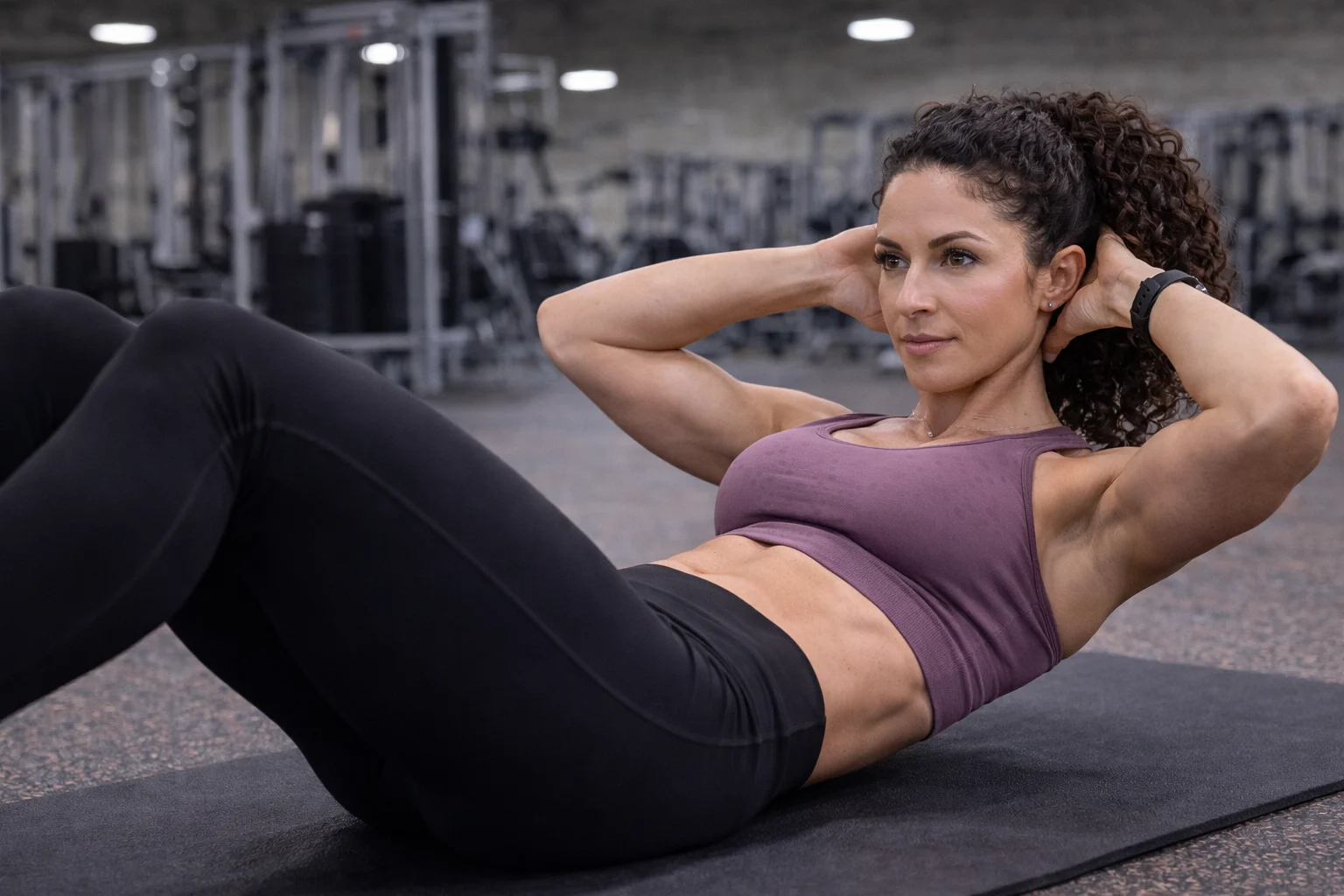
The crunch is a fundamental abdominal exercise that isolates the rectus abdominis through spinal flexion. When performed correctly with proper range of motion and tempo, it builds muscular endurance and definition in the front of your core without excessive strain on your lower back.
Muscles Worked
Primary Muscles
- Rectus Abdominis (Upper Portion)
- Internal Obliques
- External Obliques
Secondary Muscles
- Transverse Abdominis
- Hip Flexors (Minimal)
- Serratus Anterior
How to Perform
-
1
Setup: Lie on your back with knees bent at 90 degrees and feet flat on the floor, hip-width apart. Place your hands lightly behind your head with elbows out wide, or cross your arms over your chest. Keep your lower back pressed gently against the floor.
-
2
Engage: Take a breath in, then exhale as you begin the movement. Draw your belly button toward your spine to engage the transverse abdominis. Think about shortening the distance between your ribcage and pelvis before you move.
-
3
Curl Up: Flex your spine and lift your shoulder blades off the ground by curling your ribcage toward your pelvis. The movement is small—only 30-45 degrees off the floor. Your lower back should stay on the ground throughout. Focus on spinal flexion, not hip flexion.
-
4
Squeeze: At the top of the movement, pause for a one-second squeeze, maximally contracting your abs. Exhale forcefully at this peak contraction to increase muscle engagement. Your chin should stay neutral, not tucked to chest or thrown back.
-
5
Lower: Control the descent back to the starting position over 2-3 seconds. Keep tension in your abs—don't just drop. Your shoulder blades should lightly touch the ground before the next rep. Maintain consistent tempo without momentum or bouncing.
Common Mistakes
-
Pulling on Your Neck
Using your hands to pull your head forward creates dangerous neck strain and removes tension from your abs. Your hands are just there for support—the movement comes entirely from spinal flexion, not arm pull.
-
Coming Up Too Far
Sitting all the way up turns it into a hip flexor-dominant movement and reduces ab engagement. The crunch is a small, controlled motion focusing on spinal flexion, not full trunk flexion like a sit-up.
-
Using Momentum
Rocking or using momentum to bounce up defeats the purpose of the exercise. Each rep should be slow and controlled with a pause at the top. If you're using momentum, you're doing too many reps or need to slow down.
-
Holding Your Breath
Breathing incorrectly reduces ab activation and can spike blood pressure. Exhale forcefully as you crunch up and squeeze your abs. Proper breathing mechanics actually increase the effectiveness of each rep.
Pro Tips
-
Think Small, Controlled Movement
The crunch is about quality over quantity. A 30-degree trunk curl with maximum contraction builds more muscle than 100 sloppy reps to 90 degrees. Keep the range small and the tension constant throughout the set.
-
Anchor Your Lower Back
Press your lower back into the floor throughout the entire movement. This posterior pelvic tilt protects your spine and ensures your abs, not hip flexors, do the work. Imagine flattening your spine against the ground.
-
Add Resistance Progressively
Once you can do 20+ perfect reps, progress by holding a weight plate on your chest or doing them on a decline bench. Your abs are muscles too—they need progressive overload to grow stronger and more defined.
-
Use a 3-1-3 Tempo
Take 3 seconds to curl up, hold the contraction for 1 second, then 3 seconds to lower. This time under tension approach maximizes muscle engagement and makes bodyweight crunches brutally effective without needing hundreds of reps.
Variations
Bicycle Crunch
Dynamic variation with rotation targeting obliques and full ab engagement.
Reverse Crunch
Lower ab emphasis by lifting hips and legs rather than shoulders.
Weighted Crunch
Hold a weight plate on your chest for progressive overload and strength gains.
Decline Crunch
Perform on a decline bench to increase resistance through greater range of motion.
Alternatives
Cable Crunch
Kneeling cable variation with constant tension and unlimited progressive overload.
Incline Sit-Up
Full sit-up on decline bench for increased resistance and hip flexor involvement.
Ab Wheel Rollout
Dynamic anti-extension exercise that builds serious core strength.
Hanging Leg Raise
Hanging variation emphasizing lower abs and grip strength.
Related Core Exercises

Track Your Crunch Progress
Log every set, track your personal records, and watch your strength grow with replogr. The offline workout tracker built for serious lifters.
Download replogr.