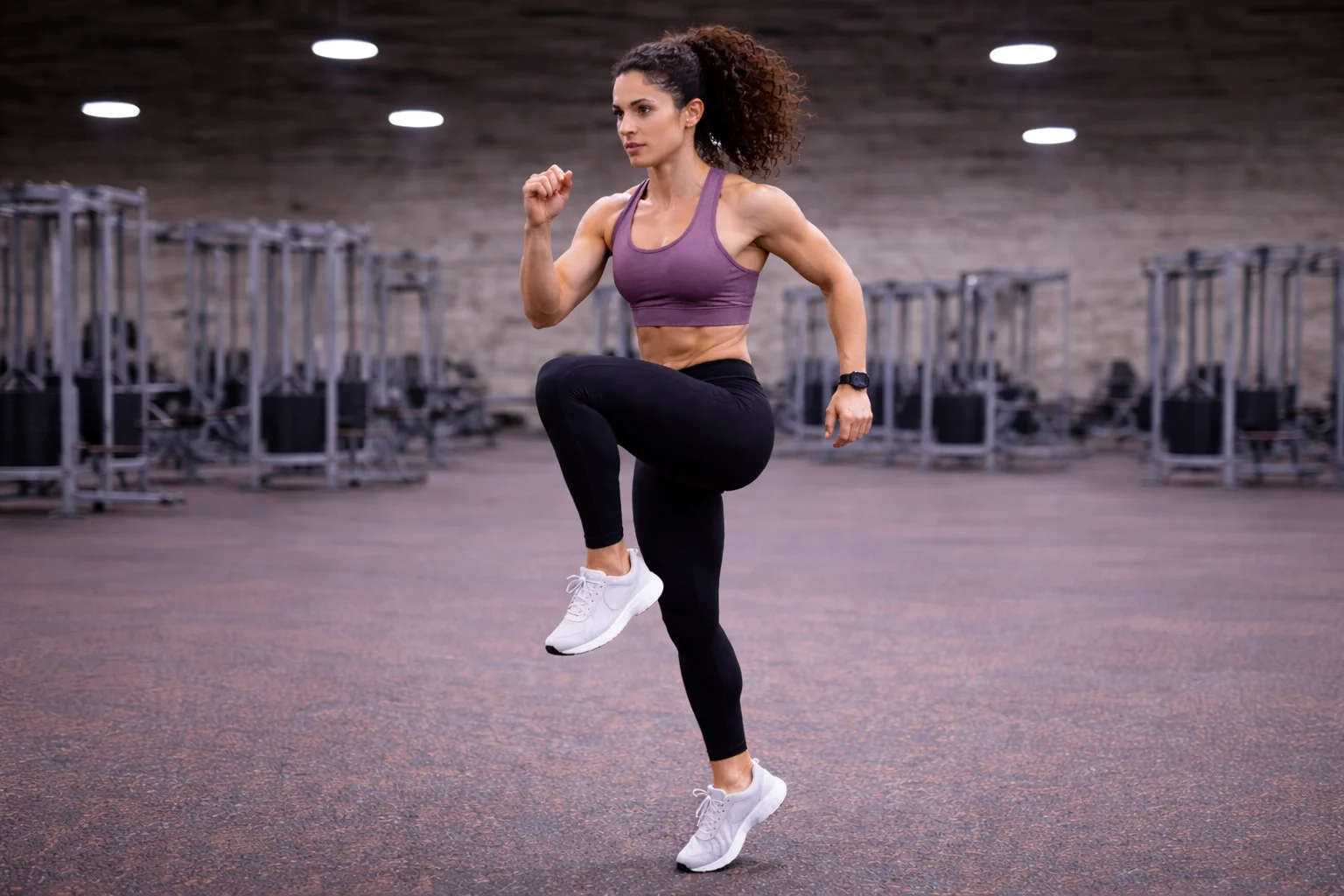
Muscles Worked
Primary Muscles
- Hip Flexors
- Rectus Abdominis
- Calves
Secondary Muscles
- Quadriceps
- Glutes
- Shoulders
How to Perform
-
1
Tall Posture: Stand upright with ribs down and eyes forward.
-
2
Drive Knees: Lift one knee to hip height while the opposite arm drives forward.
-
3
Quick Switch: Switch legs rapidly with light, fast steps.
-
4
Stay Vertical: Keep the torso stacked and avoid leaning back.
-
5
Breathe: Use short, rhythmic breaths as the pace increases.
Common Mistakes
Leaning Back
Leaning reduces core demand and slows the cadence.
Low Knees
If knees stay low, the drill turns into jogging in place.
Loud Landings
Heavy landings waste energy and stress the joints.
Training Notes
High Knees is most effective when the ribs stay down and the pelvis stays neutral. Breathe steadily and avoid holding your breath for too long. A strong brace should feel like 360° tension around the midsection, not a hard crunch.
Use slow, controlled reps and prioritize alignment over range. If the lower back arches or the hips rotate, reduce the range and build control first. A small, precise movement often trains the core better than a large, sloppy one.
For programming, 2–4 sets of 8–15 reps or 20–40 seconds work well depending on the exercise. Keep rest short and focus on quality. Core work pairs nicely at the end of a session or between heavier sets as active recovery.
If you feel the hip flexors more than the abs, reduce range or change the angle. Focus on exhaling as you finish each rep—this helps the ribs come down and increases abdominal tension. Small tweaks in posture can dramatically improve the core stimulus.
Pair High Knees with anti‑rotation or anti‑extension drills to train the trunk in multiple planes. A balanced core routine usually includes flexion, rotation control, and stability under load. Progress by adding time or slower tempos rather than chasing maximal load.
Keep the neck relaxed and the gaze neutral—tension in the neck often means the core has disengaged. If you need a regression, shorten the lever arm or add a support. Consistent, clean reps build endurance that carries over to every lift.
Think “ribs down, belt tight” at the start of every rep. This simple cue keeps the lumbar spine from over‑arching and makes the core work harder without adding load.
Progress by lengthening the lever or adding a slow pause at the hardest point. These changes increase difficulty without compromising form.
A balanced core routine is about quality, not exhaustion. Stop sets when posture starts to break and you’ll build strength that transfers to every other lift.
If you train core frequently, keep individual sessions shorter and focus on perfect reps. Small, consistent doses outperform one long session once per week.
Programming & Progression
A strong core routine balances flexion, anti‑extension, and anti‑rotation. Pick one from each category and cycle them across the week. Keep sets short and crisp to avoid turning core work into sloppy cardio.
When the goal is endurance, prioritize time under tension with clean breathing. When the goal is strength, use a heavier lever and fewer reps. Both approaches are valid, but keep posture locked in either case.
If low‑back fatigue builds quickly, reduce range and add a short pause instead. Small, precise reps train the deep core and transfer better to heavy lifts.
Pro Tips
-
Use Short Intervals
Work 20-30 seconds hard, then rest and repeat.
-
Pump the Arms
Strong arm drive increases speed and coordination.
-
Land on Midfoot
Soft landings keep the rhythm smooth.
Variations
Marching High Knees
Slow version for beginners.
Band-Resisted High Knees
Add a band for more hip flexor work.
Ladder High Knees
Use agility ladders for footwork.
High Knees to Sprint
Alternate with short sprint bursts.
Alternatives
Mountain Climber
Similar drive in a plank position.
Bear Crawl
Core control with low hover.
Step-Up
Lower-impact leg drive.
Jump Rope
Low space conditioning drill.
Related Core Exercises
Tip of the Day PRO
Focus on quality over weight. Perfect technique with moderate weight activates more muscle than heavy weight with poor form.

Track Your High Knees Progress
Log every set, track your personal records, and watch your strength grow with replogr. The offline workout tracker built for serious lifters.
Download replogr.