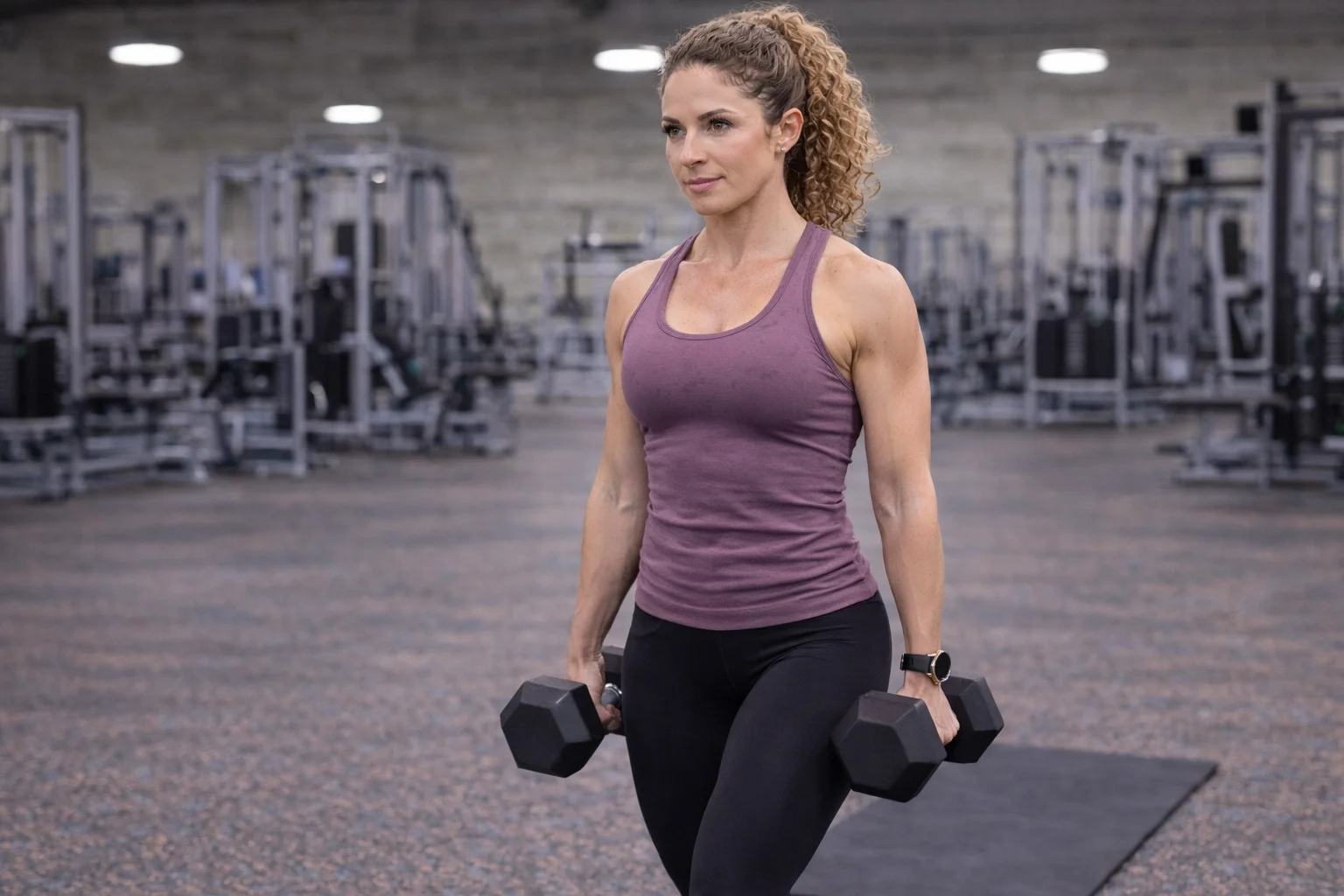
Muscles Worked
Primary Muscles
- Forearm Flexors and Extensors (Grip)
- Trapezius (Upper Back)
- Core Stabilizers (Abs and Obliques)
- Quadriceps and Glutes
- Erector Spinae (Lower Back)
Secondary Muscles
- Deltoids (Shoulders)
- Latissimus Dorsi
- Rhomboids
- Calves and Hamstrings
- Hip Stabilizers
- Serratus Anterior
How to Perform
-
1
Setup: Stand between two heavy dumbbells or kettlebells. Position your feet hip-width apart. Take a deep breath, brace your core, and hinge at the hips to grip both weights with a firm, overhand grip. Ensure your back is flat and chest is up.
-
2
Lift and Stabilize: Drive through your legs to stand up explosively, lifting both weights simultaneously. Once standing tall, pack your shoulders down and back, engage your lats, and create full-body tension. The weights should hang at your sides with arms fully extended.
-
3
Walk with Control: Begin walking forward with controlled, deliberate steps. Keep your torso upright, chest proud, and shoulders level—avoid leaning to either side. Maintain a neutral spine throughout the entire walk. Breathe naturally but keep your core braced.
-
4
Maintain Posture: Walk for the prescribed distance or time (typically 20-60 meters or 30-60 seconds). Focus on taking smooth, even steps without bouncing or swaying. Your grip should be crushing the handles—imagine trying to leave fingerprints in the metal.
-
5
Set Down Safely: When you reach the end distance or your grip is about to fail, come to a complete stop. Hinge at your hips, keep your back flat, and carefully lower the weights to the ground simultaneously. Never drop the weights while moving or with a rounded back.
Common Mistakes
Leaning to One Side
Allowing your torso to tilt sideways creates uneven loading on your spine and reduces core engagement. Use slightly lighter weights if you can't maintain a vertical torso throughout the entire walk.
Shrugging Shoulders Up
Letting your shoulders elevate toward your ears creates unnecessary neck tension and reduces upper back engagement. Pack your shoulders down actively and maintain that position throughout the carry.
Taking Tiny, Rushed Steps
Short, quick steps create instability and reduce the training effect. Take normal, deliberate strides at a controlled pace. Think "walk like you own the gym," not "shuffle in panic."
Looking Down at the Ground
Dropping your head forward compromises spinal alignment and makes balance harder. Keep your gaze straight ahead or slightly upward, maintaining a neutral neck position that aligns with your spine.
Pro Tips
-
Progressive Overload Strategy
Start with 30-40% of your body weight per hand and gradually increase. Progress by adding weight, increasing distance, or extending time. Most strong lifters work up to 50-75% of body weight per hand for 40+ meters.
-
Use Mixed Equipment for Variety
Dumbbells, kettlebells, trap bars, and specialized farmer's walk handles all provide different stimulus. Thicker handles dramatically increase grip demands. Try different implements to hit your grip and core from multiple angles.
-
Program Strategically
Farmer's carries work best at the end of your workout when you can fully empty the tank without compromising other lifts. They're also excellent for active recovery days or conditioning finishers. Aim for 2-4 sets of 20-60 meter walks.
-
Create Anti-Rotation Tension
Try single-arm carries (suitcase carry) to build serious anti-lateral flexion strength. Overhead carries develop shoulder stability. Bottom-up kettlebell carries challenge grip and shoulder stabilization at an elite level.
Variations
Suitcase Carry
Single-arm carry building intense anti-lateral flexion core strength.
Overhead Carry
Hold weight overhead to challenge shoulder stability and core control.
Trap Bar Carry
Use trap bar for heavier loads and different grip positioning.
Uneven Farmer's Carry
Different weights each hand to increase anti-rotation challenge.
Alternatives
Dead Hang
Hang from pull-up bar to build grip endurance without walking.
Plank
Isometric core stability without grip limitation.
Sled Push/Pull
Loaded movement variation with pushing or pulling mechanics.
Weighted Vest Walk
Load positioned on torso rather than hands for different stimulus.
Related Core Exercises
Tip of the Day PRO
Focus on quality over weight. Perfect technique with moderate weight activates more muscle than heavy weight with poor form.

Track Your Farmer's Carry Progress
Log every set, track your personal records, and watch your strength grow with replogr. The offline workout tracker built for serious lifters.
Download replogr.