Calf Raise (Seated)
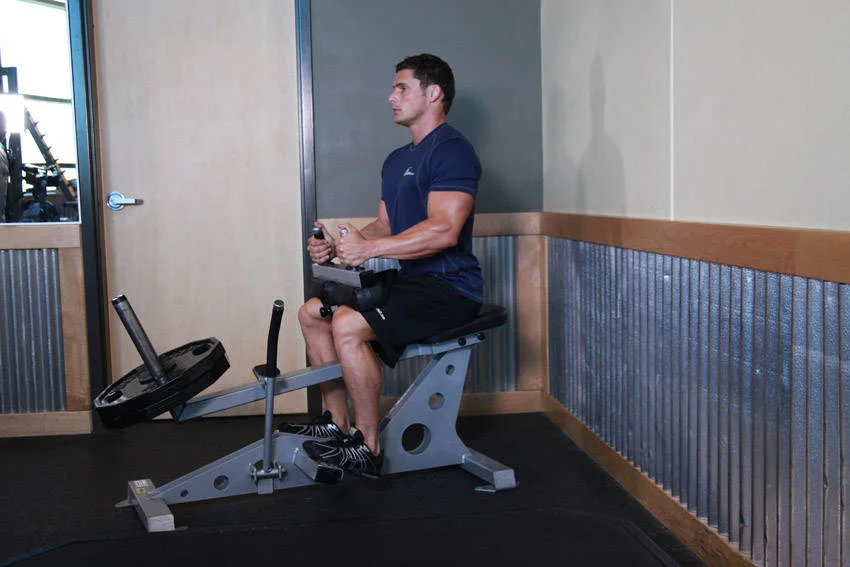
The Seated Calf Raise is an isolation exercise that specifically targets the soleus muscle of the lower leg, providing focused development of calf mass and strength. By performing the movement in a seated position with knees bent at 90 degrees, this exercise emphasizes the soleus over the gastrocnemius, making it essential for complete calf development. It's particularly valuable for athletes requiring explosive lower leg power and for those seeking balanced, well-developed calves.
Muscles Worked
Primary Muscles
- Soleus
Secondary Muscles
- Gastrocnemius
- Tibialis Posterior
How to Perform
-
1
Sit on the seated calf raise machine and position the balls of your feet on the platform with your heels hanging off the edge. Adjust the pad so it rests comfortably across your lower thighs, just above your knees.
-
2
Push up through the balls of your feet to lift the weight and release the safety lever. This is your starting position with your calves under tension and heels slightly below parallel.
-
3
Lower your heels slowly and with control, allowing them to drop below the level of the platform until you feel a deep stretch in your calf muscles. Maintain this stretched position briefly without bouncing.
-
4
Drive through the balls of your feet to raise your heels as high as possible, contracting your calf muscles forcefully at the top of the movement. Focus on achieving maximum range of motion.
-
5
Hold the contracted position at the top for one second, squeezing your calves intensely to maximize muscle engagement and time under tension.
-
6
Lower back down slowly to the stretched position and repeat for the desired number of repetitions. Maintain consistent tempo and avoid using momentum throughout the set.
Common Mistakes
-
Using Excessive Weight
Loading too much weight forces you to use partial range of motion and momentum rather than controlled muscle contraction. This reduces soleus activation and increases injury risk to the Achilles tendon.
-
Bouncing at the Bottom
Using a bouncing motion at the stretched position removes tension from the muscle and relies on elastic recoil rather than muscular contraction, significantly reducing effectiveness and potentially straining the connective tissues.
-
Incomplete Range of Motion
Failing to achieve a full stretch at the bottom or complete contraction at the top significantly limits muscle fiber recruitment and development potential, particularly affecting the soleus muscle's growth.
-
Rushing the Repetitions
Performing reps too quickly reduces time under tension and diminishes the stretch-contract stimulus that calves require for growth. Slow, controlled movements are essential for optimal soleus development.
Pro Tips
-
Emphasize the Stretch
Hold the bottom stretched position for 2-3 seconds on each rep to maximize muscle fiber activation and increase flexibility. This extended stretch significantly enhances soleus development and improves ankle mobility.
-
Use Higher Rep Ranges
Calves respond exceptionally well to higher repetitions (15-20+ reps per set) due to their high percentage of slow-twitch muscle fibers. Train them with multiple high-rep sets for optimal growth stimulus.
-
Experiment with Foot Positioning
Adjust your foot angle slightly on different sets: toes pointed straight, slightly inward, or slightly outward. This variation targets different portions of the calf complex and ensures complete development.
-
Train Calves Multiple Times Weekly
Due to their endurance-oriented fiber composition and quick recovery capacity, calves benefit from frequent training. Include seated calf raises 2-3 times per week for accelerated development.
Variations
Try these variations to challenge your calves differently and prevent training plateaus:
-
Single-Leg Seated Calf Raise
Perform the exercise one leg at a time to address muscle imbalances and increase intensity without adding weight.
-
Dumbbell Seated Calf Raise
Place dumbbells on your thighs while seated on a bench with feet on an elevated platform for a machine-free alternative.
-
Paused Seated Calf Raise
Add 2-3 second pauses at both the top and bottom positions to increase time under tension and muscular control.
-
Tempo Seated Calf Raise
Use a slow 4-second lowering phase and explosive lift to maximize eccentric loading and muscle damage for growth.
Alternative Exercises
If you don't have access to a seated calf raise machine or want to vary your training, consider these effective alternatives:
-
Standing Calf Raise
Emphasizes the gastrocnemius muscle more than the soleus, providing complementary calf development when combined with seated raises.
-
Leg Press Calf Raise
Performed on the leg press machine with bent knees to target the soleus similar to seated raises but with different loading mechanics.
-
Donkey Calf Raise
A bent-over variation that intensely stretches the calves while targeting both the gastrocnemius and soleus muscles simultaneously.
-
Smith Machine Seated Calf Raise
Place the Smith machine bar across your thighs while seated to replicate the seated calf raise when dedicated equipment isn't available.

Track Your Calf Raise (Seated) Progress
Log every set, track PRs, and watch your strength grow with replogr.
Join Beta