Seated Leg Curl
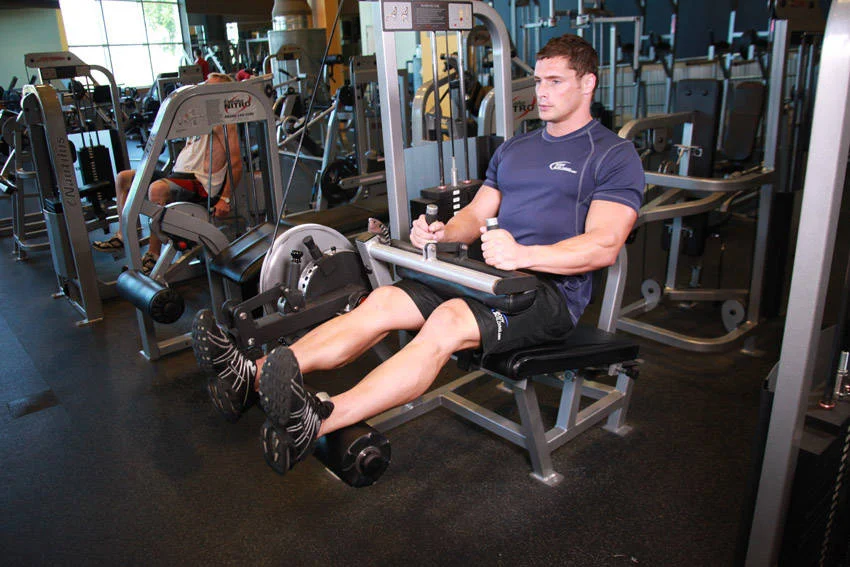
The Seated Leg Curl is an isolation exercise that targets the hamstrings through knee flexion in a controlled, seated position. This machine-based movement allows you to focus purely on hamstring development while minimizing lower back strain, making it ideal for both muscle building and rehabilitation purposes. By isolating the hamstrings, this exercise helps correct strength imbalances and enhance overall leg development.
Muscles Worked
Primary Muscles
- Hamstrings (Biceps Femoris, Semitendinosus, Semimembranosus)
Secondary Muscles
- Gastrocnemius (Calves)
- Sartorius
How to Perform
-
1
Adjust the machine so the back pad supports your lower back and the leg pad rests just above your heels when seated. Select an appropriate weight that allows for controlled movement.
-
2
Sit down and place your legs on top of the padded lever, ensuring your knees are aligned with the machine's pivot point. Your legs should be fully extended to start.
-
3
Grasp the handles for stability and lean back slightly against the back pad. Keep your torso stable throughout the movement to maintain proper form.
-
4
Exhale as you curl your legs downward by flexing your knees, pulling the pad toward your glutes as far as comfortably possible. Focus on contracting your hamstrings throughout the movement.
-
5
Pause briefly at the bottom of the movement, squeezing your hamstrings for maximum muscle engagement. Maintain control without allowing momentum to take over.
-
6
Inhale as you slowly return to the starting position, extending your legs in a controlled manner. Resist the weight on the way up rather than letting it pull your legs back quickly.
-
7
Complete the desired number of repetitions while maintaining consistent form. Avoid locking out your knees completely at the top to keep constant tension on the hamstrings.
Common Mistakes
-
Using Momentum Instead of Muscle
Swinging the weight up and letting it drop rapidly reduces hamstring activation and increases injury risk. Focus on slow, controlled movements throughout the entire range of motion.
-
Improper Seat Adjustment
If the pivot point doesn't align with your knees, you'll place unnecessary stress on the knee joint and limit hamstring engagement. Always adjust the machine to fit your body proportions.
-
Lifting Your Glutes Off the Seat
Rising off the seat during the curl shifts tension away from the hamstrings and can strain your lower back. Keep your glutes firmly planted throughout the entire set.
-
Using Excessive Weight
Loading too much weight forces you to use poor form and reduces the exercise's effectiveness. Choose a weight that allows you to complete the full range of motion with control.
Pro Tips
-
Point Your Toes for Maximum Engagement
Flexing your feet and pointing your toes forward or slightly outward helps isolate the hamstrings by reducing calf involvement, leading to better muscle activation and growth.
-
Use a 2-Second Squeeze at Peak Contraction
Holding the contracted position for two seconds at the bottom of each rep increases time under tension and maximizes hamstring fiber recruitment for superior muscle development.
-
Experiment with Foot Position
Rotating your feet slightly inward targets the outer hamstrings, while rotating outward emphasizes the inner hamstrings. Varying foot position adds diversity to your training stimulus.
-
Implement Drop Sets for Intensity
After reaching failure, immediately reduce the weight by 20-30% and continue for additional reps. This advanced technique pushes your hamstrings beyond their normal limits for enhanced growth.
Variations
Try these variations to add diversity to your hamstring training and target the muscles from different angles.
-
Single-Leg Seated Curl
Perform the exercise one leg at a time to address muscle imbalances and increase focus on each hamstring individually.
-
Pause Reps
Hold the fully contracted position for 3-5 seconds on each rep to increase time under tension and muscular endurance.
-
1.5 Rep Method
Curl down fully, come halfway up, curl down again, then return to the starting position. This counts as one rep and extends time under tension.
-
Eccentric-Focused Curls
Take 4-5 seconds to return to the starting position, emphasizing the eccentric phase to maximize muscle damage and growth stimulus.
Alternative Exercises
If you don't have access to a seated leg curl machine or want to mix up your routine, these alternatives effectively target the hamstrings.
-
Lying Leg Curl
The classic hamstring isolation exercise performed face-down on a machine, offering similar benefits with a different body position.
-
Nordic Hamstring Curl
A bodyweight exercise that builds exceptional hamstring strength and injury resilience through eccentric loading.
-
Swiss Ball Hamstring Curl
A functional alternative using a stability ball that also engages your core and glutes while targeting the hamstrings.
-
Glute-Ham Raise
An advanced compound movement that heavily loads the hamstrings while also engaging the glutes and lower back.

Track Your Seated Leg Curl Progress
Log every set, track PRs, and watch your strength grow with replogr.
Join Beta