Single-Leg Calf Raise
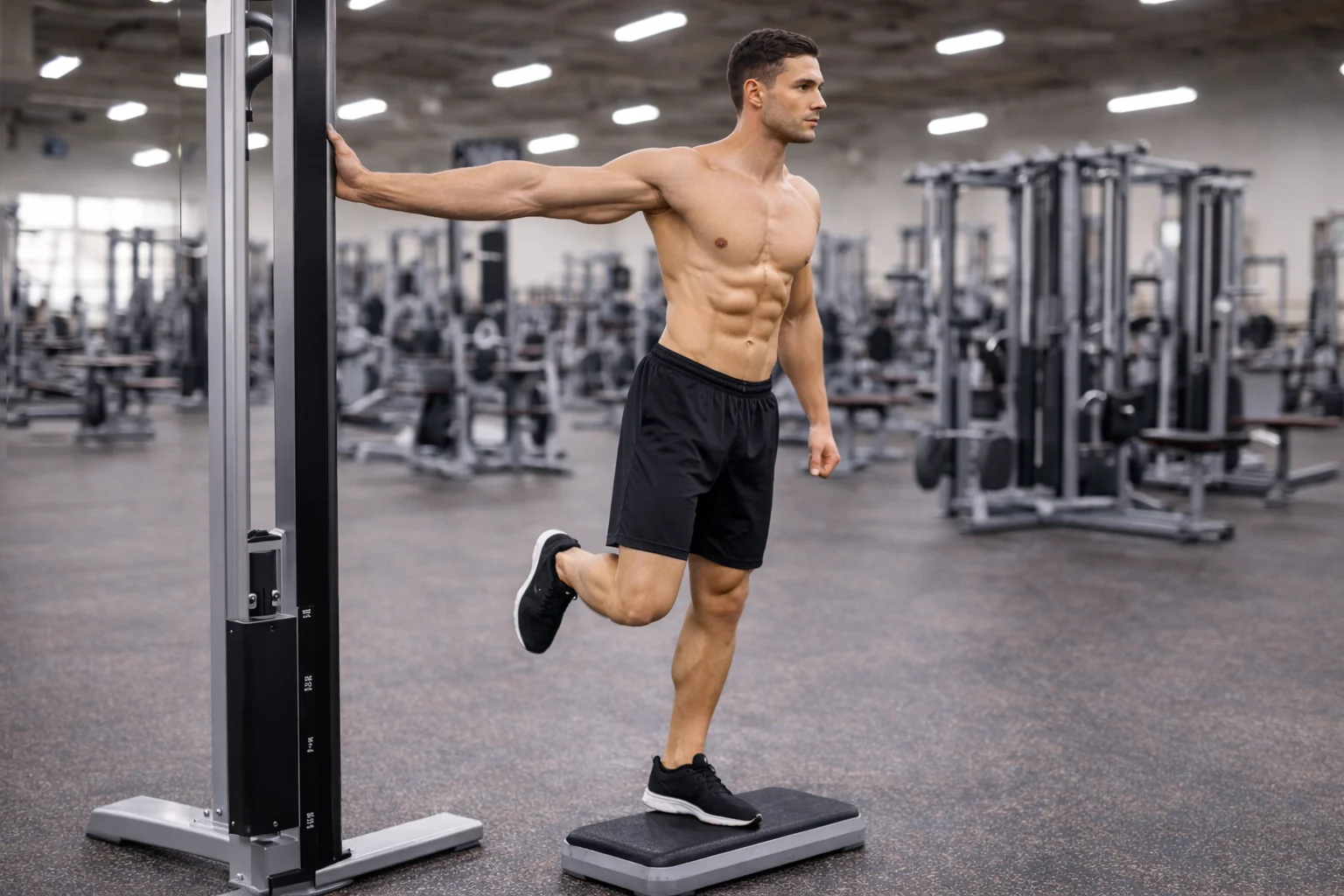
The Single-Leg Calf Raise is a unilateral exercise that builds powerful, defined calves while addressing muscle imbalances between legs. By training one leg at a time, you achieve greater muscle activation and range of motion compared to bilateral calf exercises. This movement is essential for runners, athletes, and anyone seeking aesthetic calf development and lower leg strength.
Muscles Worked
Primary Muscles
- Gastrocnemius
- Soleus
Secondary Muscles
- Tibialis Posterior
- Foot Stabilizers
How to Perform
-
1
Stand on the edge of a step or raised platform with the ball of one foot, allowing your heel to hang off the edge. Hold onto a wall or rail for balance.
-
2
Lift your non-working leg slightly off the platform, either by bending your knee or wrapping it behind your working leg. Maintain an upright posture with your core engaged.
-
3
Lower your heel below the level of the step, allowing a deep stretch through your calf muscle. This starting position maximizes your range of motion.
-
4
Push through the ball of your foot to raise your heel as high as possible, contracting your calf muscle fully at the top. Drive straight up without rolling your ankle.
-
5
Pause at the top position for one second, squeezing your calf muscle as hard as you can to maximize activation and muscle fiber recruitment.
-
6
Lower back down slowly and with control to the stretched position. Avoid bouncing at the bottom, which can lead to Achilles tendon injury.
-
7
Complete all reps on one leg before switching to the other. For added resistance, hold a dumbbell in the hand on the same side as your working leg.
Common Mistakes
-
Bouncing at the Bottom
Using momentum by bouncing out of the stretched position puts excessive stress on the Achilles tendon and reduces calf muscle engagement. Move smoothly through the full range.
-
Bending Your Knee
Allowing your knee to bend shifts emphasis to the soleus and reduces gastrocnemius activation. Keep your leg straight with just a slight natural bend throughout.
-
Insufficient Range of Motion
Not lowering your heel below the platform level or failing to rise to full toe point limits muscle growth potential. Use the complete range for best results.
-
Rolling Ankles Inward or Outward
Letting your ankle roll during the movement can cause injury and creates uneven development. Push straight up through the ball of your foot with stable ankle alignment.
Pro Tips
-
Start With Bodyweight First
Master the movement pattern and build ankle stability with bodyweight before adding external resistance. This foundation prevents injury and ensures proper form.
-
Train High Reps for Best Results
Calves respond exceptionally well to higher rep ranges (15-25 reps per set). The slow-twitch muscle fiber dominance in calves means they need extended time under tension.
-
Use a 3-1-3 Tempo
Take three seconds to raise up, pause for one second at the top, and take three seconds to lower down. This controlled tempo maximizes muscle tension and growth stimulus.
-
Train Calves Multiple Times Per Week
Due to their endurance-based nature, calves can handle frequent training. Hit them 3-4 times weekly with varied rep ranges for optimal development.
Variations
These variations challenge your calves from different angles and intensities to promote complete development.
-
Weighted Single-Leg Calf Raise
Hold a dumbbell or kettlebell in the hand on the same side as your working leg to increase resistance and build greater strength.
-
Seated Single-Leg Calf Raise
Perform the exercise seated with your knee bent to specifically target the soleus muscle underneath the gastrocnemius.
-
Explosive Single-Leg Calf Raise
Push up explosively from the stretched position while maintaining control on the descent to develop power and fast-twitch muscle fibers.
-
Toes-In/Toes-Out Variations
Point your toes inward or outward to shift emphasis to different portions of the calf complex for complete development.
Alternative Exercises
These exercises provide different training stimuli for complete calf development when combined with or substituted for single-leg calf raises.
-
Standing Calf Raise (Bilateral)
The traditional two-legged version allows you to handle heavier weight and build overall calf mass effectively.
-
Donkey Calf Raise
Performed with your torso bent forward, this variation provides an intense stretch and targets the gastrocnemius from a unique angle.
-
Jump Rope
A dynamic exercise that builds calf endurance, power, and cardiovascular fitness while providing high-volume training stimulus.
-
Calf Raise on Leg Press Machine
Using the leg press platform allows you to load heavy weight safely while targeting both heads of the calf muscle.

Track Your Single-Leg Calf Raise Progress
Log every set, track PRs, and watch your strength grow with replogr.
Join Beta