Squat
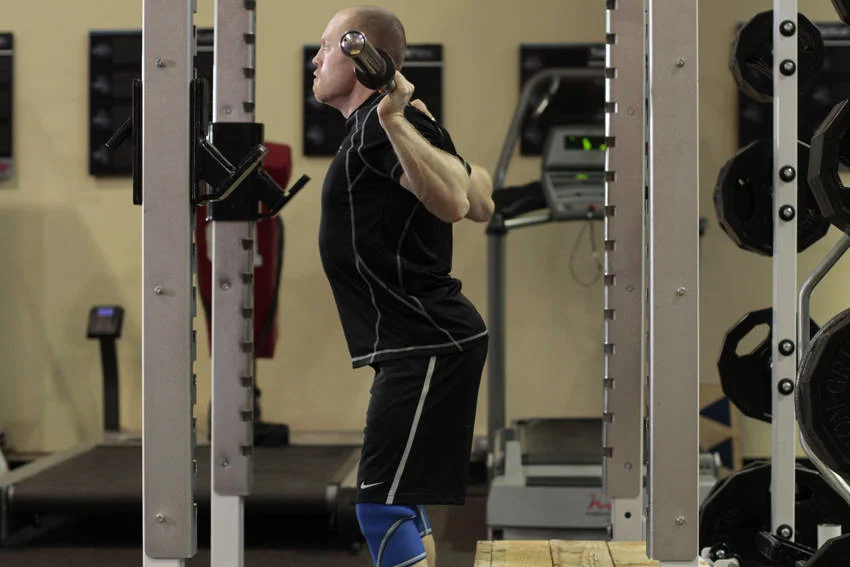
The squat is the king of all exercises, building total-body strength and mass. It targets every major muscle in your lower body while developing core stability and functional strength that carries over to daily life and athletic performance.
Muscles Worked
Primary Muscles
- Quadriceps
- Glutes
- Hamstrings
Secondary Muscles
- Core Stabilizers
- Erector Spinae
- Adductors
How to Perform
-
1
Setup: Position the bar on your upper traps (high bar) or rear delts (low bar). Step under the bar with feet shoulder-width apart, grip the bar outside your shoulders, and create upper back tightness by pulling shoulder blades together.
-
2
Unrack: Take a deep breath, brace your core hard, and stand up with the weight. Take 2-3 small steps back. Position feet shoulder-to-hip width with toes slightly pointed out (10-15 degrees).
-
3
Descend: Initiate the movement by breaking at the hips and knees simultaneously. Keep your chest up and core braced. Track your knees over your toes. Descend until your hip crease is below your knee (parallel or lower).
-
4
Drive Up: Without bouncing at the bottom, explode upward by driving through your full foot. Keep your chest up and knees out. Maintain a neutral spine throughout. Exhale as you pass the sticking point.
-
5
Lockout: Stand fully upright with hips and knees extended. Don't hyperextend your back at the top. Reset your breath and brace before the next rep. Maintain tension throughout the entire set.
Common Mistakes
-
Knees Caving Inward
Valgus collapse (knees caving) puts stress on ligaments and reduces power output. Actively push your knees out during the entire movement to maintain proper tracking.
-
Chest Collapsing Forward
Losing your chest position turns the squat into a "good morning" and stresses your lower back. Keep your chest proud and maintain thoracic extension throughout the lift.
-
Rising on Toes
Shifting weight to your toes reduces stability and quad engagement. Drive through your full foot (tripod: big toe, little toe, heel) to maintain balance and maximize force production.
-
Not Squatting Deep Enough
Partial squats limit glute and hamstring development. Aim to break parallel (hip crease below knee) unless mobility restrictions prevent proper depth with good form.
Training Notes
Squat should feel stable through the mid‑foot with the knee tracking the toes. Keep the torso braced and avoid collapsing inward at the knee. A controlled descent builds strength and keeps the joints comfortable as you increase depth or load.
Pro Tips
-
Master the Brace
Take a big breath into your belly, not your chest. Push your abs out 360 degrees like you're wearing a tight belt. This intra-abdominal pressure protects your spine and increases strength.
-
High Bar vs Low Bar
High bar (on traps) requires more upright torso and emphasizes quads. Low bar (on rear delts) allows forward lean and loads glutes/hamstrings more. Choose based on your goals and mobility.
-
Use the "Spread the Floor" Cue
Imagine trying to split the floor apart with your feet during the ascent. This external rotation cue activates your glutes, keeps knees out, and creates maximum power from the bottom position.
-
Find Your Stance
Everyone's optimal squat stance differs based on hip anatomy. Experiment with width and toe angle. The right stance allows you to hit depth with a vertical shin and upright torso while staying balanced.
Variations
High-Bar Squat
Bar rests on upper traps, requires more upright torso, emphasizes quads more than low-bar variation.
Low-Bar Squat
Bar sits on rear delts, allows more forward lean, loads glutes and hamstrings more effectively.
Pause Squat
Hold 2-3 seconds at the bottom to eliminate bounce, builds explosive strength and reinforces proper depth.
Box Squat
Squat to a box to ensure consistent depth, teaches proper hip hinge, and builds power from a dead stop.
Alternatives
Front Squat
More quad-dominant with upright torso, easier on lower back, excellent for Olympic lifting carryover.
Leg Press
Machine-based alternative that removes spinal loading, allows heavier weight with back support.
Hack Squat
Machine squat with angled platform for deep quad activation and minimal lower back stress.
Bulgarian Split Squat
Unilateral squat variation that identifies imbalances and builds single-leg strength.
Related Leg Exercises

Track Your Squat Progress
Log every set, track your personal records, and watch your strength grow with replogr. The offline workout tracker built for serious lifters.
Download replogr.