Single-Arm Lateral Raise
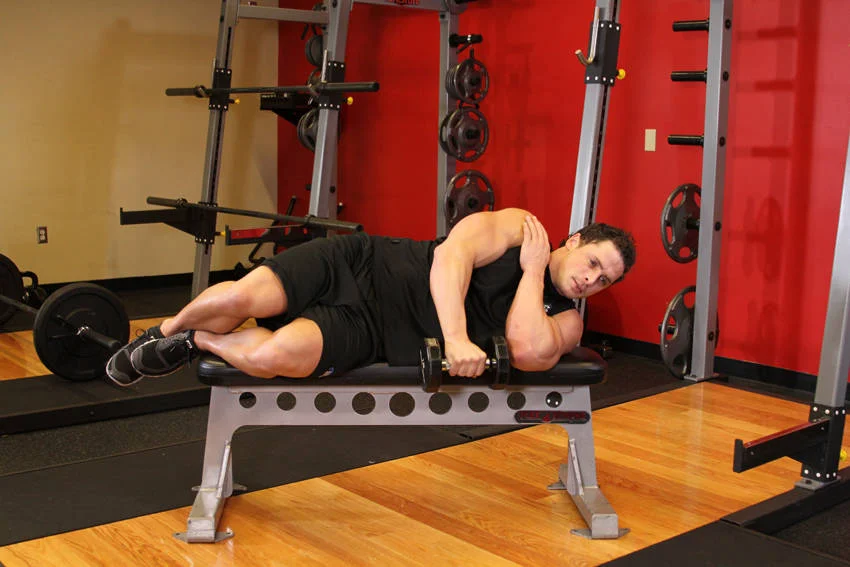
The Single-Arm Lateral Raise is a unilateral variation that allows you to focus on one deltoid at a time while improving muscle balance and stability. This exercise enhances your mind-muscle connection by isolating each shoulder individually, making it easier to address strength imbalances. The single-arm approach also allows you to use your free hand for support, enabling better form and control throughout the movement.
Muscles Worked
Primary Muscles
- Medial Deltoid (Middle Shoulder)
Secondary Muscles
- Anterior Deltoid (Front Shoulder)
- Supraspinatus (Rotator Cuff)
- Core Stabilizers
How to Perform
-
1
Stand with your feet shoulder-width apart, holding a dumbbell in one hand at your side. Your free hand can hold onto a sturdy object for balance, or rest on your hip.
-
2
Maintain a neutral spine with your core engaged. Keep a slight bend in your elbow (approximately 10-15 degrees) and lock this angle throughout the entire movement.
-
3
Begin with the dumbbell resting against your outer thigh. Position your working arm slightly in front of your body rather than directly to the side.
-
4
Lift the dumbbell out to the side in a smooth arc motion, focusing on leading with your elbow. Imagine pouring water from a pitcher as you raise the weight.
-
5
Continue raising until your arm reaches shoulder height (parallel to the floor). Your palm should be facing down or slightly tilted forward at the top position.
-
6
Pause briefly at the top while squeezing your medial deltoid, then lower the weight back down with control. The lowering phase should take 2-3 seconds.
-
7
Complete all reps on one side before switching to the other arm. Perform 3-4 sets of 12-15 reps per side.
Common Mistakes
-
Using Too Much Weight
Heavy weights force you to use momentum and recruit other muscles. Choose a weight that allows strict form for the entire set to maximize medial deltoid isolation.
-
Shrugging at the Top
Elevating your shoulder toward your ear shifts tension to the upper trapezius. Keep your shoulder down and focus on raising your arm, not your shoulder blade.
-
Leaning or Tilting Your Body
Compensatory body movement reduces effectiveness and can strain your lower back. Keep your torso stable and upright throughout the exercise.
-
Bending Your Elbow During the Movement
Changing your elbow angle turns this into an arm exercise. Lock in a slight bend at the start and maintain it throughout every rep.
Pro Tips
-
Start with Your Weaker Side
Always begin with your non-dominant arm. This ensures you don't fatigue before addressing your weaker side, helping to balance strength between both shoulders.
-
Use the Mirror for Form Checks
Position yourself in front of a mirror to monitor your form, particularly watching for shoulder shrugging, body lean, or uneven movement patterns.
-
Incorporate Pause Reps
Hold the top position for 2-3 seconds on every rep. This isometric hold maximizes medial deltoid engagement and builds incredible shoulder endurance.
-
Match Reps, Not Weight
If you notice one side is stronger, perform the same number of reps on both sides using the weight your weaker side can handle. This prevents strength imbalances from worsening.
Variations
Explore these variations to challenge your shoulders in new ways and prevent training plateaus.
-
Seated Single-Arm Lateral Raise
Sit on a bench to eliminate any leg drive or momentum, forcing your shoulders to do all the work with strict form.
-
Single-Arm Cable Lateral Raise
Use a cable machine for constant tension throughout the entire range of motion, providing a different resistance curve than dumbbells.
-
Single-Arm Incline Lateral Raise
Lie sideways on an incline bench to increase the range of motion and create a unique resistance angle at the start of the movement.
-
Single-Arm Resistance Band Lateral Raise
Step on a resistance band and perform single-arm raises for a portable option with progressive resistance as you lift.
Alternative Exercises
These exercises work the same muscle groups with different movement patterns and equipment options.
-
Standard Dumbbell Lateral Raise
The bilateral version allows you to work both shoulders simultaneously for more time-efficient training.
-
Machine Lateral Raise
Provides a fixed movement path and easy weight adjustment, perfect for drop sets or training to failure safely.
-
Upright Row
A compound movement that targets the medial deltoids along with the upper traps, using heavier weights for overall shoulder development.
-
Arnold Press
Incorporates rotation to hit all three deltoid heads, providing comprehensive shoulder development in one movement.

Track Your Single-Arm Lateral Raise Progress
Log every set, track PRs, and watch your strength grow with replogr.
Join Beta